Comparing SMA and BNC: 7 Key Differences You Need to Know
16
Mar
Coaxial Cable Assembly
Microwave Test Cable
Coaxial RF Connector
Coaxial RF Adapter
Coaxial RF Termination
Coaxial RF Test Probe
Coaxial RF Attenuator
RF Switches
Rotary Joints
RF Circulators
Coaxial RF Power Dividers
RF Couplers
RF Filters
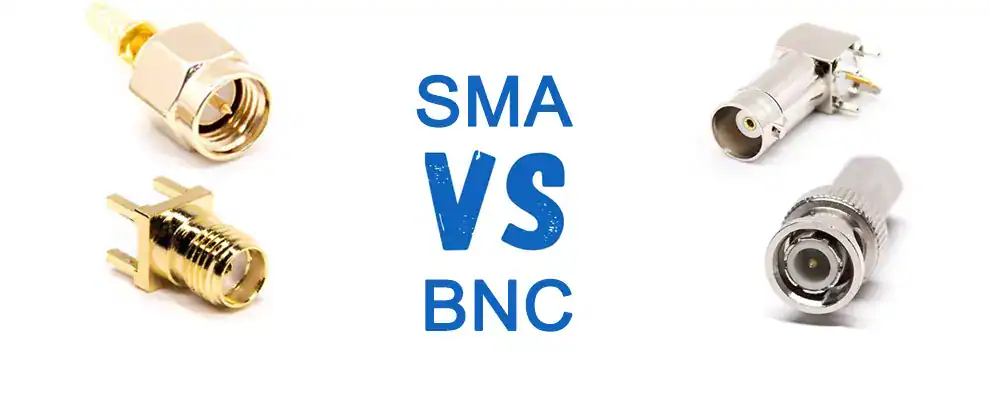
When you’re weighing SMA vs BNC for your next RF or microwave project, the SMA vs BNC decision directly impacts signal integrity, reliability, and system performance. As an RF engineer, you’ve probably felt the frustration of picking the wrong connector and watching VSWR spike or a connection loosen under vibration. That’s why understanding the SMA vs. BNC connector differences matters so much.
In the next few minutes, you’ll discover seven practical differences that will help you choose faster and with confidence. Whether you need a BNC to SMA connector adapter for a hybrid test bench or an SMA to BNC cable for legacy equipment, the right pick saves time, money, and redesign headaches.
You know the feeling: you need to swap instruments quickly in the lab. A BNC-type connector with its quarter-turn bayonet lock lets you connect and disconnect in seconds. That quick action is why BNC remains popular for benchtop oscilloscopes and video gear [4].
SMA, on the other hand, uses a threaded coupling. You screw it on firmly, and it stays put. As a microwave engineer, you’ll appreciate this when vibration or movement is involved – no accidental disconnects. The SMA vs. BNC connector choice here is simple: use BNC for speed, SMA for security.
Frequency is the deal-breaker.Standard BNC frequency range typically reaches around 4 GHz for 50Ω versions, while actual performance depends on connector quality, cable design, and application requirements[1]. Above that, the slots in the outer conductor start radiating, and your return loss suffers.
SMA connectors comfortably handle DC to 18 GHz, with precision versions reaching 26.5 GHz [2]. If your 5G, radar, or satellite link runs at 6 GHz or higher, you need the SMA connector frequency range advantage. Many engineers I’ve worked with switched from BNC cables to SMA and immediately saw cleaner spectrum traces.
| Parameter | BNC Connector | SMA Connector |
|---|---|---|
| Typical Frequency Range | DC to 4 GHz | DC to 18 GHz |
| Precision Version | Up to around 6 GHz | Up to 26.5 GHz |
| Impedance | 50Ω / 75Ω | 50Ω |
| Connection Method | Bayonet coupling | Threaded coupling |
| Main Application | Test instruments, RF measurement | Microwave, radar, wireless systems |
SMA is noticeably smaller – perfect for high-density boards and compact modules. You’ll often reach for a small bulkhead connector when mounting through an enclosure wall because the thread and smaller footprint leave more room for other ports.
BNC is larger and easier to grip, which is why you still see it on older test gear. When space is tight, or you’re designing for IoT/5G infrastructure, the compact SMA coaxial connector wins every time [3].
Think about an aerospace qualification test or a vehicle-mounted radio. Threaded SMA connectors pass MIL-STD vibration and shock without loosening. The bayonet BNC can walk off under sustained vibration – a painful lesson many of us have learned the hard way [4].
If your system lives in a harsh environment, the SMA vs. BNC durability gap is non-negotiable. SMA gives you peace of mind; BNC forces extra tie-downs or lock-washers.
High-quality SMA connectors are rated for 500 mating cycles minimum when tested to MIL-DTL-83517 standards. You can mate and unmate repeatedly in automated test setups without worrying about wear.
BNC is fine for occasional lab use, but wears faster at the bayonet fingers. For production or field-replaceable units, the extra cycles of SMA pay for themselves quickly.
A colleague needed to characterise a 3.5 GHz bandpass filter. He started with bnc-bnc cable assemblies and saw 3 dB extra insertion loss plus unstable VSWR. Switching to SMA RF cable assemblies dropped the loss to 0.8 dB and stabilised the measurement. Frequency range was the culprit – classic BNC vs. SMA lesson.
During MIL-STD-810 vibration qualification, BNC connectors on the test harness loosened after 2 hours. Replacing every connection with male SMA connectors and SMA plug versions kept the system locked for the full 8-hour profile. The threaded coupling made the difference.
You have a vector network analyser with BNC ports, but need to connect a 12 GHz antenna. A simple BNC to SMA RF adapter plus SMA to coax adapter chain solved it without replacing the entire instrument. Quick, inexpensive, and fully functional up to the SMA limit.These examples show why thousands of RF engineers now default to SMA for anything above 4 GHz.
BNC is usually cheaper, and you’ll find ready BNC male-female stock everywhere. But when you need to bridge old and new gear, SMA to BNC cable or BNC to SMA connector adapters are inexpensive and plentiful.
A quick note on a common variant: many engineers ask about the TNC vs. the BNC connector. TNC is simply the threaded version of BNC – same size, same frequency limit, but far more vibration resistant. If you love BNC’s form factor yet need better hold, consider the TNC connector vs. BNC before jumping to SMA.
For high-frequency or space-constrained work, you’ll also encounter SMA k connector (2.92 mm) or SMA rf connector variants. Having a few SMA coax adapter pieces in your kit is standard practice.
| Selection Factor | sma cables,bnc cables | sma type connector | types of bnc connectors | Practical Takeaway |
|---|---|---|---|---|
| Frequency range | Better for microwave work and higher bands | Up to 18 GHz or higher on precision parts | Usually below 4 GHz | Choose SMA when frequency margin matters |
| Coupling style | Threaded and secure | Threaded | Bayonet and quick-turn | Choose BNC when fast swaps matter |
| Space and panel density | Better for compact layouts | Smaller footprint | Larger body | Choose SMA in tight enclosures |
| Vibration resistance | Better in harsh or mobile systems | Stronger retention | Moderate | Choose SMA for rugged or compact systems |
| Typical use | Microwave, radar, antennas | RF and microwave builds | Lab, video, lower-frequency RF | Match the connector to the system, not the price |
You now have a clear mental map of SMA vs BNC – from coupling style and BNC frequency range limits all the way to real-world mating cycles and adapter strategies. Choosing correctly means fewer field failures, cleaner measurements, and faster time-to-market.
Choose SMA instead of BNC when you need 50 Ω above ~4 GHz, lower VSWR, and threaded coupling.
Yes—choose BNC when you work in lower-frequency RF systems (≤4 GHz): cost-effective, easy to mate.
Choose SMA for vibration or mobile equipment: threaded coupling, better retention and repeatability.
Expect 500–1000 mating cycles from a high-quality SMA connector; you specify cycles and torque on PO.
Coaxial Cable Assembly
Microwave Test Cable
Coaxial RF Connector
Coaxial RF Adapter
Coaxial RF Termination
Coaxial RF Test Probe
Coaxial RF Attenuator
RF Switches
Rotary Joints
RF Circulators
Coaxial RF Power Dividers
RF Couplers
RF Filters
Please send a message to us and we will reply to you ASAP, thank you.