
 Coaxial Cable Assembly
 Microwave Test Cable
 Coaxial RF Connector
 Coaxial RF Adapter
 Coaxial RF Termination
 Coaxial RF Test Probe
 Coaxial RF Attenuator
 RF Switches
 Rotary Joints
 RF Circulators
 Coaxial RF Power Dividers
 RF Couplers
 RF Filters
Introduction
When you’re weighing BNC vs TNC connector choices for your next RF or microwave project, the decision directly affects signal integrity, reliability, and long-term performance. The BNC vs TNC connector comparison often leaves engineers wondering which one will hold up best in real-world conditions. You might have felt the frustration of a connection loosening at the wrong moment or watched VSWR spike because the wrong coupling type was chosen. This guide walks you through the practical differences so you can select with confidence.
As an RF engineer, you know these connectors keep critical systems running—from test benches to field deployments. Understanding the tnc vs bnc options helps you avoid costly redesigns and ensures your coaxial cable bnc connector or tnc cable performs exactly as needed.
Understanding the BNC Connector Definition and Types
You start by getting clear on the basics. A BNC connector’s meaning is a quick-connect RF interface named Bayonet Neill-Concelman. It uses a simple quarter-turn bayonet lock that clicks into place in seconds. The BNC connector definition highlights its 50 ohm or 75 ohm impedance options, making it versatile for both RF signals and video applications.
Types of bnc you commonly see include straight male and female versions, right-angle designs, and bulkhead mounts. A 50 ohm BNC connector is your go-to for most microwave work, while BNC female connectors or BNC bulkhead connectors simplify panel installations. You’ll also run across coaxial cable BNC connector assemblies that terminate RG-58 or RG-59 cables cleanly.
In my experience, the speed of a BNC makes lab work feel effortless—yet that same ease can become a liability when vibration enters the picture.
What Is a TNC Connector? Exploring TNC RF Connector Features
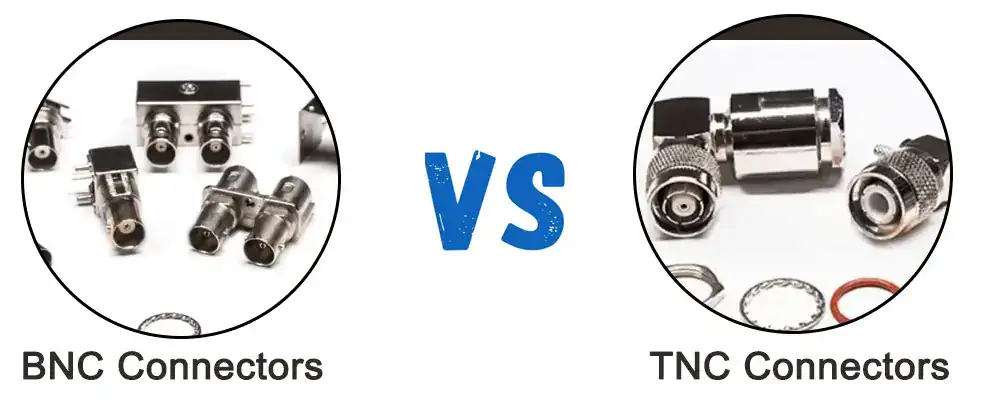
Now shift to the threaded alternative. A tnc connector (Threaded Neill-Concelman) looks almost identical to its bayonet cousin but replaces the quick-lock with a reliable screw thread—usually 7/16-28 UNEF. This tnc rf connector delivers the same compact size you love but adds serious mechanical strength.
You’ll find tnc male connector, tnc female connector, tnc cable, tnc bulkhead connector, and even tnc female bulkhead connector or tnc jack connector options. Specialised variants include tnc 90 degree connector, tnc right angle connector, coax tnc connector, and reverse polarity tnc connector (often called rp tnc connector or rp tnc male connector). These tnc connector cable assemblies shine in high-vibration or outdoor environments where a tnc to bnc connector adapter might be needed for hybrid setups.The threaded design gives you peace of mind—once tightened, it stays put.
BNC vs TNC Connector: The Core Differences You Need to Know
When you compare BNC vs TNC, three factors stand out: coupling method, frequency handling, and vibration resistance. Let’s break them down so you can decide fast.
Coupling Mechanism – Bayonet vs Threaded
Your BNC snaps on with a twist and releases just as quickly—perfect when you swap instruments dozens of times a day. The TNC requires a few extra turns but locks with far more force. If you’ve ever had a BNC connector type connection vibrate loose during a long test run, you already feel why many engineers upgrade to the TNC connector vs BNC for field use.
BNC Frequency Range Compared to TNC Performance
Standard BNC frequency range tops out around DC to 4 GHz before the slotted outer conductor starts radiating and impedance drifts. In contrast, a tnc connector comfortably reaches 11 GHz—and in precision versions even higher—because the threads eliminate leakage paths.
Vibration Resistance and Durability
Here, the tnc vs bnc connector gap becomes obvious. Bayonet styles can micro-move under shock or continuous vibration, introducing noise or intermittent faults. Threaded TNC versions resist this movement, delivering consistent contact pressure over thousands of mating cycles.
The RF coaxial connectors engineering notes from South Dakota School of Mines and Technology [3] explain that above 4 GHz, the BNC slots may radiate, while the TNC version resolves leakage and stability issues up to 12 GHz—exactly the upgrade you need in harsh conditions.
TNC vs BNC: Real-World Cases That Show Which to Pick
You don’t have to guess. These three scenarios I’ve seen repeatedly in RF labs and field deployments make the choice crystal clear.
Case 1: Lab Test Bench (Choose BNC)
You’re calibrating an oscilloscope or spectrum analyser with frequent cable swaps. A standard BNC cable definition setup with quick bayonet connectors cuts setup time dramatically. One engineer I worked with reduced daily calibration cycles from 45 minutes to under 10 by sticking with BNC—pure efficiency when vibration isn’t a factor.
Case 2: Aerospace Vibration Testing (Choose TNC)
An avionics module endured 20 g random vibration for 8 hours. The original BNC female connector loosened, causing 3 dB insertion-loss spikes. Switching to a tnc right-angle connector with a bulkhead mount eliminated the problem entirely. Data from the same test run showed VSWR staying below 1.3 across the band.
Case 3: Wi-Fi Antenna Installation (Choose RP-TNC)
Outdoor access points exposed to wind and weather need reverse-polarity protection to meet FCC rules. Using an RP TNC male connector and a TNC female bulkhead connector prevented accidental mating with standard coax while maintaining 6 GHz performance. The installation has survived two hurricane seasons with zero failures.These examples prove that matching the connector to the environment saves time, money, and headaches.
Choosing Between types of bnc connector and tnc coax connector for RF Builds
| Selection Factor | BNC | TNC | Practical Takeaway |
|---|---|---|---|
| Frequency range | Best below 4 GHz | Comfortable to about 11 GHz | Use TNC for higher-frequency RF work |
| Coupling style | Bayonet, quick-turn | Threaded, secure | Use BNC for fast swaps, TNC for hold |
| Vibration resistance | Moderate | Better | Use TNC in mobile or outdoor systems |
| Form factor options | bnc connector right angle, bulkhead styles | tnc connector male, tnc connector female, 90 degree tnc connector | Use right-angle parts in tight layouts |
| Cable integration | Common with standard RF bench cables | Strong fit with tnc connectors semirigid cable | Use semirigid when routing must stay fixed |
When you torque a TNC, use a calibrated wrench set to the manufacturer’s spec—over-tightening cracks the dielectric; under-tightening invites vibration trouble. For BNC, a gentle quarter-turn until it clicks is enough—no tools required.
Why Getting BNC vs TNC Connectors Right Matters to You
You invest countless hours designing circuits that must perform flawlessly in the real world. A mismatched connector turns a solid RF chain into an unreliable link. Choosing correctly means fewer field returns, happier customers, and systems that stay online when it counts most.
Whether you need the lightning-fast swaps of a BNC connector type setup or the rock-solid hold of a TNC RF connector, the right pick saves you time and protects your reputation.
Final Thoughts on Choosing BNC or TNC for Your Projects
The BNC vs TNC connector decision ultimately comes down to your priorities: speed and convenience versus ruggedness and extended frequency. You now have the clear differences, real cases, and step-by-step guidance to decide with confidence.