
 Coaxial Cable Assembly
 Microwave Test Cable
 Coaxial RF Connector
 Coaxial RF Adapter
 Coaxial RF Termination
 Coaxial RF Test Probe
 Coaxial RF Attenuator
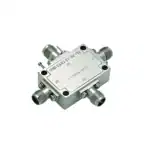 RF Switches
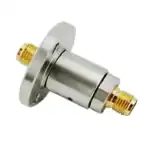 Rotary Joints
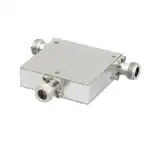 RF Circulators
 Coaxial RF Power Dividers
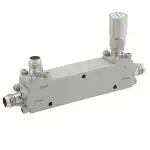 RF Couplers
 RF Filters
Introduction
RF circulators are the parts you notice only when a radar or satellite chain starts behaving badly. A 3-port RF circulator is not there to look clever on a datasheet. It is there to send reflected energy away from sensitive devices, keep the isolation stable, and protect the front end under real mismatch and heat. If you work in technical procurement or system integration, this is a system-protection decision, not a small accessory choice.
Why RF circulators matter in satellite and radar systems
You need RF circulators when the receiver is expensive, the transmitter is vulnerable, or the reflected power can turn a good design into a support problem. MIT Lincoln Laboratory states that ferrite circulators are used in radar systems to isolate transmitters from reflected energy and direct return signals into receiver channels. The University of North Texas describes a circulator as a three-port device that lets low-loss power flow from source to load while diverting reflected power to a third terminated port. That is the core job you are buying. [3]
If you are comparing an RF microwave circulator, a broadband RF circulator, or a high-power RF circulator, the question is always the same: can it protect the chain you actually run? In real projects, the answer depends on frequency, power, isolation, and how much mismatch the system will see in the field. [4]
What high isolation buys you
High isolation gives you a cleaner receiver, less source stress, and fewer surprises during integration. Smiths Interconnect’s L, S, and X-band high-power circulators are designed for SSPA radar applications, including AESA radar, ground surveillance, shipboard defense, and airborne fire control. Their datasheet shows practical values such as 20 dB minimum isolation, 0.30 dB max insertion loss, and power handling up to 3 kW peak in L-band configurations. That is the level of evidence you should want from RF circulator manufacturers. [5]
How you should choose a better RF microwave circulator
Start with the system, not the catalog. Define the band first, then forward power, reflected power, connector format, and temperature range. Only after that should you compare isolation, insertion loss, and power handling. That order saves time because it keeps you from buying a part that looks right on paper but fails once the assembly is under real load. [1]
Bandwidth is useful, but it is never free
If you need a broadband RF circulator, you are always trading bandwidth against loss and isolation. A University of Colorado study on ferrite-based circulators shows that changing the ferrite fill factor can move 1 dB bandwidth from 5% to 36.2%, while insertion loss increases and isolation decreases as the design shifts away from the optimum point. NASA’s millimeter-wave report adds a practical benchmark: high-performance microstrip circulators were investigated for 36 to 40 GHz operation over -20°C to +50°C, with isolation and return loss greater than 16 dB and insertion loss less than 0.7 dB in the reported Ka-band device. [2]
That is the real lesson for you. Wider bandwidth can help a satellite payload or a test bench, but it always comes with trade-offs. If your project cares more about stable isolation than raw coverage, a narrower and more controlled design can be the smarter choice.
Power margin is a reliability filter
If you need a high power rf circulator or a rf high power circulator, treat power margin as a reliability requirement, not a bonus. Smiths Interconnect shows high-power circulators built for L, S, and X-band defense applications, with options for compact mechanical formats and internal terminations that can form isolators. The UNT report also notes that future RF sources for TeV-scale systems may require 50 to 100 MW per source, and that a circulator is a common device for protecting an RF source from reflected power. That tells you why power handling must be checked early, not late.
For many radar and microwave systems, the practical question is simpler: can the part survive mismatch, heat, and repeated stress without drifting out of spec? If the answer is unclear, keep looking.
Procurement comparison at a glance
| Application | What you should prioritize | Useful benchmark |
|---|---|---|
| Radar receive protection | High isolation and reflected-power control | Ferrite circulators isolate transmitters and route return signals to receiver channels. |
| Satellite front end | Stable isolation, low loss, and temperature tolerance | 36–40 GHz operation over -20°C to +50°C; >16 dB isolation; <0.7 dB insertion loss in NASA’s report. |
| Broadband microwave lab | Bandwidth versus loss trade-off | 1 dB bandwidth from 5% to 36.2% depending on ferrite fill factor. |
| High-power radar chain | Power margin and mismatch tolerance | L/S/X-band high-power circulators with 20 dB min isolation, 0.30 dB max insertion loss, and up to 3 kW peak power in the datasheet. |
What to ask RF circulator, manufacturers
When you compare RF circulator manufacturers, ask for the data that matches your real operating conditions. You want insertion loss, isolation, power handling, connector type, temperature range, and the frequency band clearly stated. If the supplier cannot explain what happens at the edge of the band or under mismatch, that is a warning sign. The best supplier is not the one with the loudest claims. It is the one that can prove performance with numbers you can trust.
For you, the value of a circulator is simple: it protects expensive hardware, keeps reflected power under control, and makes the whole system easier to trust. That is why selection should be driven by engineering need, not by brochure language or price alone.
Conclusion
RF circulators sit at the point where RF design becomes system protection. If you choose the wrong one, you may lose more than a few dB. You may create extra stress on the source, reduce receiver confidence, and shorten the life of the front end. If you choose well, your satellite or radar chain becomes calmer, cleaner, and easier to trust. The best decision is not only about the part number. It is about isolation, bandwidth, power handling, and whether the device matches the mission you actually run.