
 Coaxial Cable Assembly
 Microwave Test Cable
 Coaxial RF Connector
 Coaxial RF Adapter
 Coaxial RF Termination
 Coaxial RF Test Probe
 Coaxial RF Attenuator
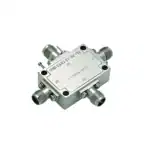 RF Switches
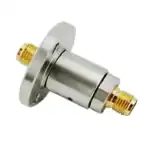 Rotary Joints
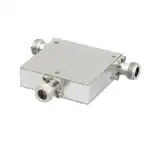 RF Circulators
 Coaxial RF Power Dividers
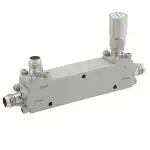 RF Couplers
 RF Filters
Introduction
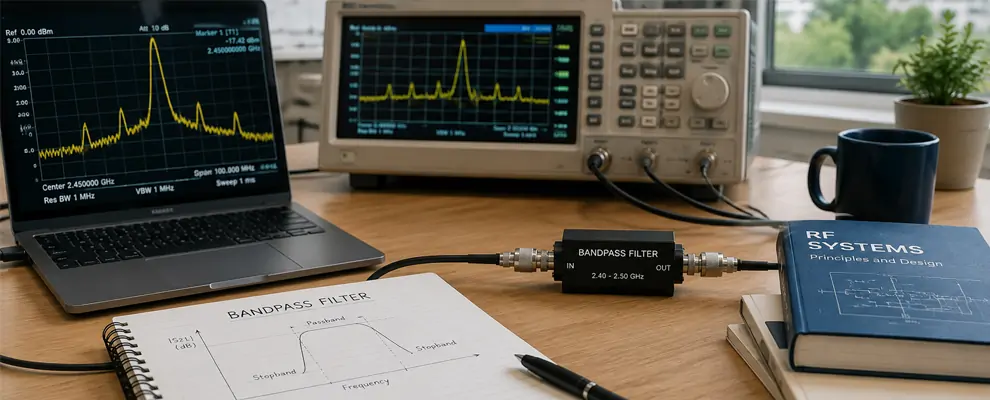
A Bandpass filter is the part you reach for when the source is noisy, but the signal still matters. If your sensing design keeps failing because it hears too much junk, bandpass filtering is often the fastest way to get back to a trace you can trust. You keep the band you want, reduce what you do not, and make the analyzer or receiver easier to live with. In RF and microwave work, that is why bandpass filters stay relevant in both lab cleanup and production screening.[1]
Why Bandpass Filtering Matters
In front-end wireless systems, RF bandpass filters are used to pre-select the desired band and reject interferers. As systems become more multifunctional, multi-band, and tunable, parts matter more because they can cover several bands without forcing a redesign. If you are working on a receiver chain, that means the filter is doing more than shaping the spectrum. It is protecting the rest of the chain from being overwhelmed.[2]
The sensing pain point
When the sensing front end keeps failing, it is often because the filter is too generic for the real load. Once the source is bandpass filtered, harmonics and nearby clutter stop masquerading as useful information. That is what makes spectrum analysis calmer and bring-up faster: you stop chasing ghosts and start seeing the actual device behavior.
Why does load behavior keep breaking good designs
Texas Instruments shows how easily a design can miss spec when the load is ignored. In its ADC example, the target was a 60 MHz passband centered at 184 MHz with ripple under 0.5 dB, but the filter had to be adjusted after the ADC input impedance was absorbed into the design. The last shunt capacitor changed from 13.5 pF to 11.4 pF, and the load resistor changed from 200 Ω to 215 Ω. That is the practical lesson: the right filter is not just about the shape on paper. It has to survive the real load.[4]
Choosing Between Standard and Custom Bandpass Filters
Standard bandpass filters are fine when the band is familiar and the load is friendly. But once the enclosure gets tight, the impedance starts to move, or the passband is no longer ordinary, custom bandpass filters become the safer path. The same is true for custom RF bandpass filters, especially when you need the filter to fit a real front end instead of a neat textbook schematic. TI’s low-sensitivity filter guidance also shows why tuning for parasitics matters: if you do not account for component spread, the response drifts before the system ever ships.
| Selection factor | Standard part | Custom part | What it means for you |
|---|---|---|---|
| Bandwidth | Common bands | Narrow or unusual bands | Go custom when the passband is specific |
| Load behavior | Friendly load | Impedance-sensitive front end | Go custom when the load shifts the response |
| Packaging | Off-the-shelf fit | Tight mechanical fit | Go custom when space is limited |
| Risk | Faster start | Lower redesign risk | Go custom when repeatability matters |
That table is the simplest way to frame the decision. If your bandpass filtering goal is only basic cleanup, standard parts may be enough. If your goal is a stable product or a repeatable lab setup, custom bandpass filters usually save more time than they cost.
What Real Designs Show
Published designs show the same pattern from different angles. UC Davis reports absorptive bandpass filters that improve passband flatness and provide good impedance matching both in-band and out-of-band. They also note that conventional filters can create mismatches that hurt nearby nonlinear devices such as ADCs, mixers, and high-gain amplifiers. In other words, the filter is not only shaping the signal. It is also keeping the rest of the chain from being disturbed.[3]
Analog Devices gives a second useful example. Its resonant 4th-order Butterworth bandpass filter uses a 200 MHz center frequency for a 250 MSPS receiver front end, and the design emphasizes source impedance matching and antialiasing. In the measured circuit, the final receiver reached about 72.5 dBFS SNR and approached 90 dBc SFDR, which is exactly the kind of result you want when source cleanup has to preserve signal shape rather than distort it.[5]
| Case | Data point | Why it matters |
|---|---|---|
| TI ADC front end | 60 MHz passband, 184 MHz center, ripple under 0.5 dB, 13.5 pF to 11.4 pF, 200 Ω to 215 Ω | Shows why load-aware design prevents spec drift |
| UC Davis absorptive filter | Better passband flatness and good impedance matching in and out of band | Helps with source cleanup and nearby device protection |
| Analog Devices receiver front end | 200 MHz center, 41 MHz 1 dB BW, 89 MHz 3 dB BW, 72.5 dBFS SNR, ~90 dBc SFDR | Shows how clean filtering supports measurement quality |
| TI low-sensitivity design | Tuning method to compensate parasitics | Helps when component variation keeps changing the response |
If your sensing design has been failing in the same annoying way every time, these examples show why. The problem is rarely just “noise.” It is usually a mismatch between the band you think you want and the behavior the real front end actually gives you. That is where bandpass filters become a practical tool instead of a theory exercise.
Conclusion
A Bandpass filter is not just something that hides unwanted frequencies. It is how you make spectrum analysis honest and source cleanup repeatable. If your build is simple, standard bandpass filters may be enough. If the band is tight, the load is touchy, or the enclosure is unforgiving, custom bandpass filters and custom RF bandpass filters are usually the better answer. For RF and microwave engineers, that means a cleaner source, a calmer trace, and fewer surprises when the design moves from bench to production.
References
FAQ
1. When should you choose custom bandpass filters instead of standard parts?
Choose custom bandpass filters when your passband is narrow, the enclosure is tight, or the load shifts the response. Custom work reduces redesign risk and fit issues.
2.What makes rf bandpass filters important in sensing front ends?
RF bandpass filters help remove harmonics and nearby clutter before they reach the analyzer or receiver. That keeps the trace cleaner and makes the real signal easier to trust.
3. How do you know if bandpass filtering is strong enough for your system?
Check passband width, insertion loss, and out-of-band rejection. If the filter only looks good on paper but distorts the real load, it is not strong enough for production use.
4. What should you compare before buying custom rf bandpass filters?
Compare bandwidth, rejection, package size, power handling, and tuning range. The right filter should fit your band, your enclosure, and your maintenance plan.
5. When is a standard bandpass filter enough?
A standard bandpass filter is usually enough when the band is common, the load is stable, and the package is not constrained. For unusual bands, custom is safer.