
 Coaxial Cable Assembly
 Microwave Test Cable
 Coaxial RF Connector
 Coaxial RF Adapter
 Coaxial RF Termination
 Coaxial RF Test Probe
 Coaxial RF Attenuator
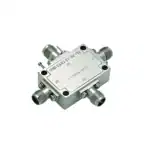 RF Switches
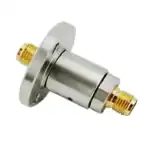 Rotary Joints
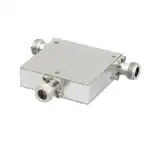 RF Circulators
 Coaxial RF Power Dividers
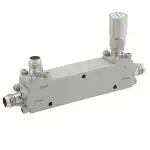 RF Couplers
 RF Filters
Introduction
If you design phased arrays, MIMO receivers, or multi-channel test racks, RF power dividers decide whether your channels stay aligned or slowly drift apart. You are not just splitting a signal. You are setting the loss budget, the isolation between channels, and the amount of calibration pain you will carry later. For technical procurement teams and system integrators, that makes the choice of RF power divider a system decision, not a line item.
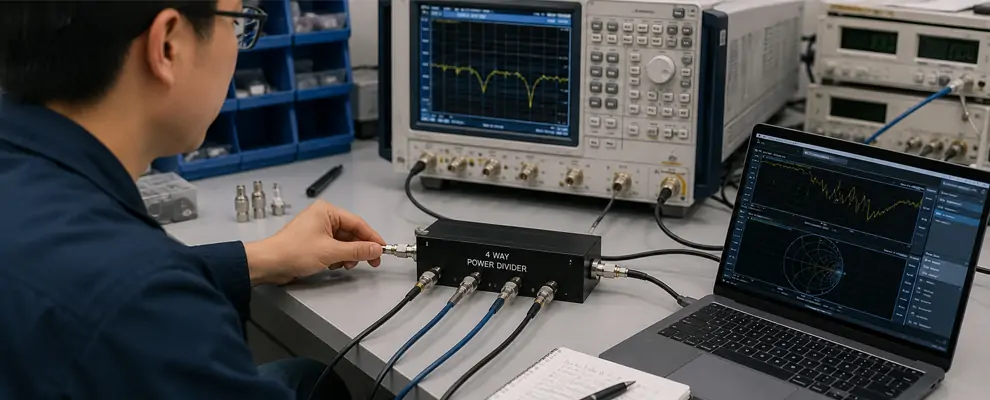
That is why port count matters so much. A 2-way RF power divider, 4-way RF power divider, 6-way RF power divider, or 8-way RF power divider does not simply change how many outputs you get. It changes how much power each channel sees, how much mismatch you have to absorb, and how much time you spend proving that the channels still behave like one system.
The first thing it changes is the signal budget.
Split loss grows with port count.
A divider always costs you power. For an ideal split, the loss follows 10 log10(N), so the theoretical split loss is about 3 dB for 2-way, 4.8 dB for 3-way, 6 dB for 4-way, 7.8 dB for 6-way, and 9 dB for 8-way. That is the part you cannot avoid. The real RF power divider loss is the split loss plus the extra insertion loss created by mismatch and internal dissipation.[1]
Why that matters in practice
In a multi-channel system, every extra dB matters. Less power per channel means less margin, less receiver headroom, and more sensitivity to cable loss, connector loss, and device variation. That is why you should think of RF power dividers as budget setters. They do not just feed the channels; they decide how much performance is left after the split.
Smaller splits are usually easier to live with
If you need the tightest control, a 2-way RF power divider is usually the cleanest starting point. A 3-way RF power divider is less common, but when the architecture forces it, you accept a mid-point loss budget. A 4-way RF power divider is often the practical compromise. Once you move into 6-way RF power divider and 8-way RF power divider territory, you gain channel density, but you pay for it with more loss and more calibration work.
More channels mean more matching pain.
Balance and isolation set the calibration load.
A well-designed divider should give you high isolation, low insertion loss, and good VSWR. Mini-Circuits says that directly, and Marki makes the same point in simpler language: power dividers create copies of the same signal while ideally preventing crosstalk between outputs. In real multi-channel work, that is where the pain starts. The more outputs you add, the harder it becomes to keep amplitude and phase aligned without extra calibration.[3]
What procurement should ask
If you are comparing 2-way RF power divider suppliers, 3-way RF power divider suppliers, 4-way RF power divider suppliers, 4-way RF power divider suppliers, or RF power divider suppliers, do not stop at the port count. Ask for amplitude balance, phase balance, isolation, return loss, and the exact definition of insertion loss. A good supplier will separate the theoretical split from the real RF power divider loss, so you can compare parts honestly.
A simple rule you can trust
In practice, fewer outputs usually mean easier balance and less correction later. That is why a 2-way part often feels easier to integrate, a 4-way part often feels like the practical middle ground, and an 8-way part feels like a small system project all by itself. That is not marketing. It is what happens when one input must stay coherent across many outputs.[2]
High power and combining change the rules again
When you need a high-power RF power divider
If your system is feeding a transmit chain, a phased-array feed network, or a test setup that must move more power, you should look for a high power RF power divider instead of a generic splitter. Keysight notes that power dividers are used for coherent power splitting in phased-array radar feed networks, LO distribution, radio measurements, and power combining. That means the divider is part of the active RF path, not just a passive accessory.[5]
Divider versus combiner is not just a label.
Mini-Circuits explains that when a divider is used as a combiner, power handling depends on whether the signals are coherent or not. For non-coherent signals, the effective power per port is limited by the per-port rating divided by the number of ports. In other words, the same part can behave very differently depending on how you use it. That is why a high-power RF power divider should always be chosen with the real operating mode in mind.[4]
The selection mistake to avoid
Do not choose the part by port count alone. A high-port divider may look convenient, but if your channels need clean amplitude matching and low RF power divider loss, the extra ports can become the most expensive decision in the system. If the application is a tight calibration, fewer outputs are usually safer. If the application is a dense distribution, you accept more loss and more test time.
Quick comparison for multi-channel systems
2-way | 3.0 dB | Lowest channel burden, easiest matching | Tight balance, simple fan-out |
3-way | 4.8 dB | Uncommon, but useful when topology forces it | Special distribution layouts |
4-way | 6.0 dB | Practical compromise between density and control | Antenna feeds, test racks |
6-way | 7.8 dB | More channel density, more correction work | Larger distribution networks |
8-way | 9.0 dB | Highest loss and highest calibration pressure | Dense multi-channel systems |
Theoretical split loss follows 10 log10(N). Real RF power divider loss is higher because of insertion loss, mismatch, and internal dissipation. See Keysight and Mini-Circuits for divider behavior and real-world tradeoffs.
Conclusion
So, how do RF power dividers affect multi-channel RF performance? They set the power budget, the isolation budget, and the calibration burden. A 2-way RF power divider gives you the cleanest control. A 4-way RF power divider is often the practical middle ground. A 6-way RF power divider or an 8-way RF power divider gives you channel density, but the tradeoff is more RF power divider loss, more balancing work, and more time spent proving the system. If you choose the part based on what the channels really need, not just how many ports you want on paper, your RF system is easier to trust and cheaper to support.
References
[1] Keysight, Differences in Application Between Power Dividers and Power Splitters.
[2] Marki Microwave, How do RF and Microwave Power Splitters, Dividers, and Combiners Work?
[3] Mini-Circuits, AN10-006 Understanding Power Splitters.
[5] Keysight, Microstrip and CPW Power Divider Design.
FAQ
1. How do I choose between a 2-way RF power divider and a 4-way RF power divider?
Choose a 2-way RF power divider when you need the lowest split loss and the cleanest balance. Choose a 4-way RF power divider when you need more channels and can accept higher loss.
2. What changes when I move from a 4-way RF power divider to an 8-way RF power divider?
You gain more output ports, but you also lose more power, need more calibration, and usually face looser balance. An 8-way RF power divider is better for density than for lowest loss.
3. When should I look for a high-power RF power divider?
Use a high-power RF power divider when the divider may handle transmit power, phased-array feeds, or combining jobs. You should confirm both divider-mode and combiner-mode power limits before purchase.
4. What should I ask RF power divider suppliers before ordering?
Ask for full-band insertion loss, isolation, return loss, amplitude balance, and phase balance. These numbers tell you whether the divider will stay stable in real multi-channel RF use.
5. How often should I replace or requalify an RF power divider?
Requalify after any system change, high-power event, or unexplained drift in channel balance. For production or lab systems, keep traceable test records so you can compare old and new performance.