
 Coaxial Cable Assembly
 Microwave Test Cable
 Coaxial RF Connector
 Coaxial RF Adapter
 Coaxial RF Termination
 Coaxial RF Test Probe
 Coaxial RF Attenuator
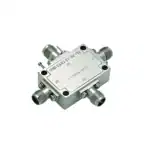 RF Switches
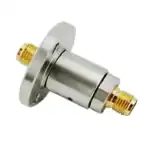 Rotary Joints
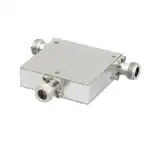 RF Circulators
 Coaxial RF Power Dividers
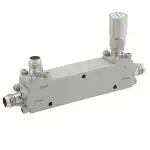 RF Couplers
 RF Filters
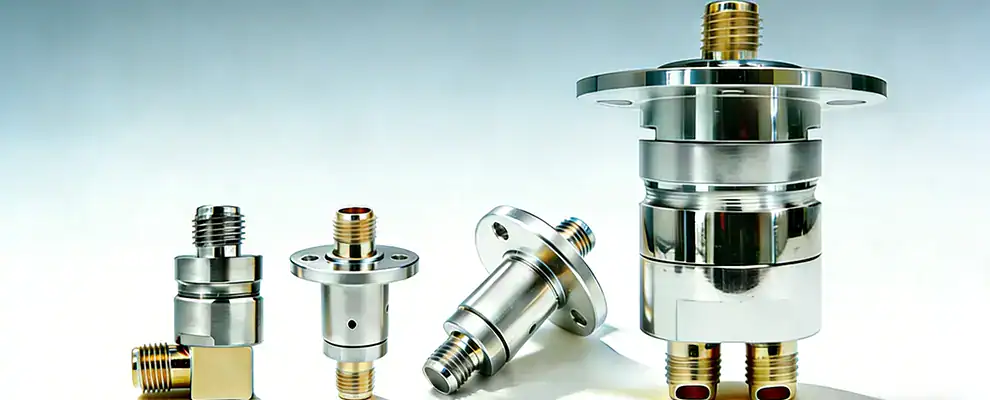
Introduction: Why is RF Rotary Joint Selection So Important?
In high-frequency applications such as radar systems, satellite communications, microwave antennas, and medical equipment, the RF rotary joint (also known as high-frequency rotary joint or coaxial rotary joint) plays a critical role as the “signal lifeline.” It must transmit GHz-level high-frequency signals during 360° unlimited rotations while ensuring no signal distortion or packet loss.
However, many engineers focus only on “whether the frequency is high enough” during selection, overlooking the “invisible killers” that truly determine signal quality: insertion loss fluctuation, VSWR stability, and impedance matching accuracy. Selecting the wrong parameter can lead to signal attenuation at best, or complete system failure at worst.
This guide will systematically analyze the five core parameters for RF rotary joint selection, provide specific selection steps, and offer reference scenarios to help you make the most suitable decision.
I.What Is an RF Rotary Joint?
An RF rotary joint is a precision electromechanical device specifically designed to transmit high-frequency signals (typically ranging from 10MHz to 50GHz). It allows equipment to transmit RF signals, microwave signals, and even high-speed digital signals without interruption during continuous 360° rotation.
RF Rotary Joint vs. Standard Slip Ring: What’s the Essential Difference?
Comparison Dimension | Standard Slip Ring | RF Rotary Joint |
Operating Frequency | Typically, <100MHz | 10MHz~50GHz or higher |
Core Design Focus | Contact resistance | 50Ω or 75Ω characteristic impedance matching |
Key Indicators | Contact resistance fluctuation | VSWR, Insertion Loss, Isolation |
Typical Applications | Industrial automation, security monitoring | Radar, satellite communication, microwave antennas |
More importantly, modern RF rotary joints are often “high-frequency + electrical” integrated components—capable of transmitting not only RF signals but also power, control signals, and even fluid media simultaneously. This integrated design not only saves space but also simplifies system structure.
II.The Four-Step RF Rotary Joint Selection Process
Step 1: Define Signal Type and Frequency
- Is the signal to be transmitted RF signal, video signal, or high-speed digital signal?
- What is the operating frequency band? What is the maximum frequency?
Step 2: Determine Channel Configuration
- How many RF channels are needed? (1 channel/2 channels/multi-channel?)
- Is simultaneous transmission of control signals at different frequencies required? (What frequency? How many channels?)
Step 3: Lock Key Indicator Thresholds
Based on system requirements, determine the minimum acceptable values for the following indicators:
- VSWR ≤ ? (Typically, ≤1.5, high-end requirements ≤1.3)
- Insertion Loss ≤ ? dB (Typically ≤0.5dB, high-end requirements ≤0.3dB)
- Isolation ≥ ? dB (Typically ≥50dB)
Step 4: Confirm Interface and Environmental Requirements
- Interface Type:SMA, N-Type, BNC, TNC, 2.4mm, 2.92mm, etc.
- Characteristic Impedance:50Ω or 75Ω?
- Environmental Conditions:
- Operating temperature range: Outdoor equipment requires -40°C~80°C
- Protection level: Outdoor installation requires IP67+
- Speed requirements: Confirm maximum rotation speed for continuous rotation (e.g., 300r/min)
III. Why Choose ZOMWAVE RF Rotary Joints?
Our Technical Advantages
- Excellent Electrical Performance
- VSWR ≤1.5 (can reach below 1.2 depending on frequency)
- Insertion Loss ≤0.3dB
- Isolation ≥50dB
- Comprehensive Product Series
- Frequency range: Full coverage of DC~3GHz, DC~18GHz, DC~50GHz
- Channel configuration: 1~6 RF channels
- Interface types: Multiple options including SMA, N-Type, 2.4mm, 2.92mm
- Reliable Manufacturing Process
- Gold-gold contacts, extremely low contact resistance
- High-quality stainless steel/aluminum alloy housing, adapts to harsh environments
- Dual precision rolling bearing support, low torque, high stability
- Comprehensive Customization Capability
- Supports “RF + electrical signal + fluid media” hybrid transmission
- Customizable main body outer diameter, flange mounting methods
- Fast response capability: 8-hour drawing delivery, 7-day sample production
Our Quality Assurance
- ISO9001 Quality Certification
- Multiple international certifications including CE, FC, FCC
- 10,000+ mature solution accumulations
- Frequently Asked Questions
Q1: What is the difference between an RF rotary joint and a waveguide rotary joint?
A: RF rotary joints (coaxial type) are suitable for a wide frequency range, typically DC~50GHz, with a compact structure; waveguide rotary joints are suitable for higher power, specific frequency band applications, such as 26.5~40GHz. Both have their advantages and can be selected based on specific requirements.
Q2: What protection level is needed for outdoor RF rotary joints?
A: For outdoor installation, it is recommended to choose products with IP67 or higher protection level to ensure waterproof and dustproof performance. Also, confirm whether the operating temperature range meets the requirements of -40°C~80°C.
Q3: Can RF rotary joints be customized?
A: Yes. Parameters including number of channels, frequency range, main body outer diameter, interface type, and protection level can all be customized according to your specific requirements.
Conclusion: Selecting the Right RF Rotary Joint Starts with Understanding the Parameters
Although an RF rotary joint is just a small component in the system, its impact on signal quality is system-wide. We hope that through this selection guide, you can upgrade from the single-minded focus on “whether the frequency is high enough” to a comprehensive consideration of core parameters including VSWR, insertion loss, impedance matching, channel configuration, and environmental adaptability.
If you have any questions during the selection process or need to obtain product CAD drawings or technical specifications, please feel free to contact the technical engineering team at ZOMWAVE. With over 20 years of rotary joint research and development experience and having provided customized services for benchmark clients including Huawei and Apple suppliers, we look forward to providing the most professional solutions for your project.