
 Coaxial Cable Assembly
 Microwave Test Cable
 Coaxial RF Connector
 Coaxial RF Adapter
 Coaxial RF Termination
 Coaxial RF Test Probe
 Coaxial RF Attenuator
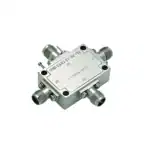 RF Switches
 Rotary Joints
 RF Circulators
 Coaxial RF Power Dividers
 RF Couplers
 RF Filters
1. What Does Your System Require? Start with Two Questions
Before opening the product list, answer these two questions. Your answers will immediately narrow the field. Below we outline the strengths of each technology so you can match them to your application.
① What switching speed do you need?
Millisecond range (10–15 ms) is sufficient → Electromechanical Relay
Nanosecond range (100–150 ns) is required → PIN Diode
② What is your continuous wave (CW) power level?
≤ 1W (+30 dBm) → PIN Diode
> 10W → Electromechanical Relay
> 100W → Electromechanical Relay is mandatory
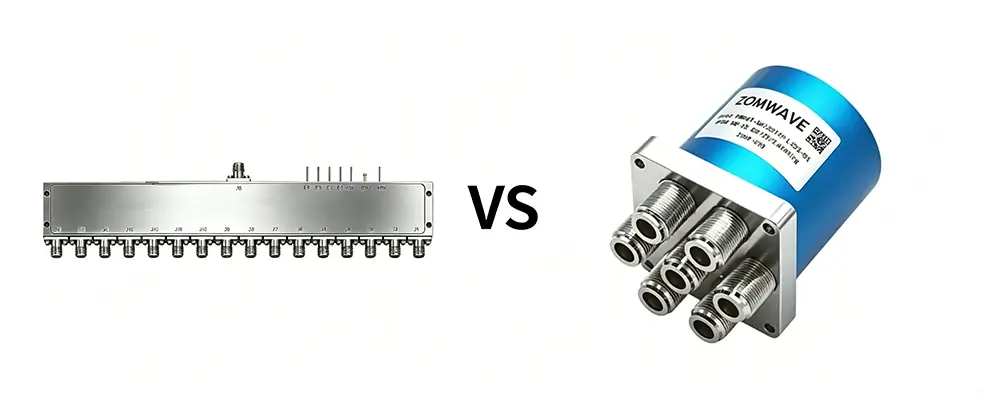
2. PIN Diode Switches — Where Speed Is the Priority
Core Advantage: Nanosecond Switching — The Standard for ATE Test Systems
PIN diode switches achieve switching speeds of 100–150 ns, more than 100× faster than electromechanical relays. In an automated test (ATE) system, saving 150 ns per switch may sound trivial, but across a test sequence that switches 1,000 times, the cumulative saving reaches 150 μs — a tangible efficiency gain on high-speed production lines.
Ideal Applications:
- Wireless Communication Testing (5G / Wi-Fi 6E / Satellite Terminals) — Multi-port signal routing requires frequent channel and band switching. PIN diode switches complete the switch the instant the control command arrives, keeping the test sequence fluid.
- Laboratory Instrument Switching (VNA / Spectrum Analyzer / Signal Generator) — When multiple instruments share a single DUT, PIN diode switches eliminate the mechanical bounce associated with relays, avoiding spurious signals during high-speed data acquisition.
- Phased-Array Antenna Feed Networks — Digital beamforming (DBF) requires real-time antenna weight updates. The nanosecond response of PIN diodes enables closed-loop beam control — a requirement that electromechanical relays simply cannot meet at millisecond latency.
- High-Volume Production Test (> 1,000 units/hour) — In production lines measured in seconds per unit, switch speed directly impacts throughput. The low latency of PIN diodes delivers measurable yield-per-hour gains.
ZOMWAVE PIN Diode Switches — Representative Products
Product | Configuration | Frequency | Speed | Power | Isolation |
Absorptive SP16T | Absorptive, 16-port | 0.4–12 GHz | 150 ns | +30 dBm | ≥80 dB |
Absorptive SP8T | Absorptive, 8-port | 0.5–40 GHz | 150 ns | +30 dBm | ≥45 dB |
Reflective SP3T | Reflective, 3-port | 26–40 GHz | 100 ns | +23 dBm | ≥45 dB |
3. Electromechanical Relay Switches — The Only Choice for High-Power Routing
Core Advantage: Power Handling up to 350W CW with Ultra-Low Insertion Loss
Electromechanical relay switches have essentially no equal in power handling — ZOMWAVE high-power N-type relays deliver up to 350W CW (DC–3 GHz), a power level completely out of reach for PIN diodes. Beyond high power, electromechanical relays also offer extremely low insertion loss (as low as <0.25 dB). In low-noise systems, every 0.1 dB matters for noise figure — relays are the only option.
Ideal Applications:
- Military Radar & Electronic Warfare Systems — Radar transmit chains require high-power RF routing. 350W CW continuous wave power is standard. Relays have been used in this application for over half a century, with a complete reliability pedigree.
- Satellite Ground Station High-Power Uplink/Downlink — Uplink power at satellite ground stations typically exceeds 100W. Relay switches route signals between antenna and power amplifier while maintaining <0.5 dB low insertion loss, reducing link budget pressure.
- Industrial Heating & Plasma RF Sources — Applications such as industrial microwave heating and medical RF ablation require routing high-power RF energy to different loads or antennas. The power rating of electromechanical relays directly matches the real-world requirements of these industrial scenarios.
- ATE High-Power Device Testing — Power amplifiers (PA), LNAs, and other high-power devices require connection to real loads during engineering validation. The high-power + low-loss combination of electromechanical relays makes them the de facto standard for this application.
ZOMWAVE Electromechanical Relay Switches — Representative Products
Product | Configuration | Frequency | Power | Insertion Loss | Isolation |
High-Power SP6T N-Type | 6-port Unterminated | DC–3 GHz | 350W CW | <0.25 dB | ≥80 dB |
Mid-Power SP6T N-Type | 6-port Unterminated | DC–12.4 GHz | 170W CW | <0.5 dB | ≥60 dB |
Precision DPDT 2.92mm | Dual DPDT | DC–40 GHz | 10W CW | <1.0 dB | ≥55 dB |
4. Quick Selection Comparison
Selection Criteria | PIN Diode | Electromechanical Relay |
Switching Speed | ≤150 ns | 15 ms |
Max Power | +30 dBm (1W) | 350W CW |
Insertion Loss | 3.5–8.5 dB | <0.25 dB |
Max Isolation | 80 dB | 80 dB |
Frequency Range | DC–40 GHz | DC–40 GHz |
Port Count | SP3T–SP16T | SPST–SP6T |
Lifecycle | Semi-permanent (no wear) | ≥1,000,000 cycles |
5. Selection Recommendation
Choose PIN Diode if: Your test system demands speed, or you need a high port count (8–16 ports), and power is ≤1W. ZOMWAVE PIN diode switches cover SP3T through SP16T, up to 40 GHz, with 5-day shipment.
Choose Electromechanical Relay if: Your link power exceeds 1W, or insertion loss is critical (low-noise systems). ZOMWAVE N-type high-power relays deliver up to 350W; precision 2.92mm types cover DC–40 GHz, all with latching design for low control power consumption.
Not sure which to choose? Describe your specific application (frequency / power / speed requirement / port count) and contact ZOMWAVE application engineers for selection support.