
 Coaxial Cable Assembly
 Microwave Test Cable
 Coaxial RF Connector
 Coaxial RF Adapter
 Coaxial RF Termination
 Coaxial RF Test Probe
 Coaxial RF Attenuator
 RF Switches
 Rotary Joints
 RF Circulators
 Coaxial RF Power Dividers
 RF Couplers
 RF Filters
Introduction
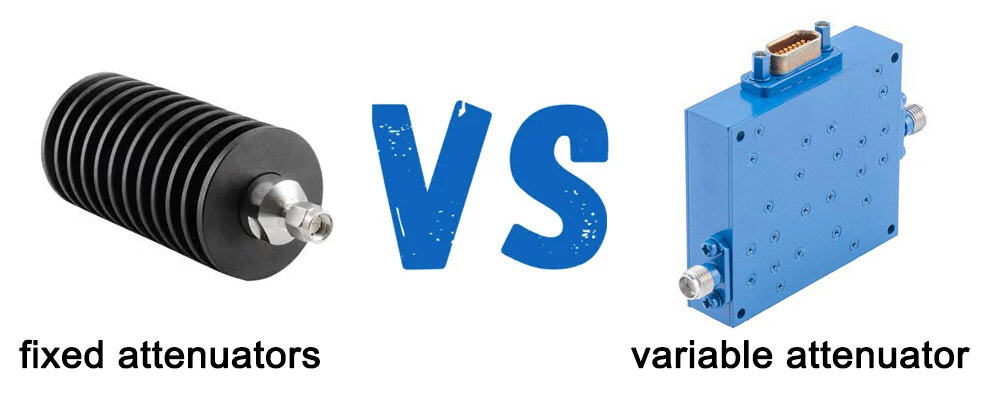
When you design or troubleshoot RF and microwave circuits, fixed attenuators and a variable attenuator quickly become essential tools for controlling signal levels. Fixed attenuators deliver a constant, preset reduction in power—think of them as reliable “set it and forget it” components—while a variable attenuator lets you dial in exactly the attenuation you need right now. Understanding this core difference helps you protect sensitive equipment, improve measurement accuracy, and keep your system impedance matched. As a microwave engineer, you have probably felt the frustration of a mismatched test setup or the satisfaction of a perfectly leveled signal in a 5G prototype. Choosing the right type saves time, prevents costly rework, and ensures your designs perform reliably in the field.
What Are Fixed Attenuators and Why Do You Rely on Them?
Fixed attenuators provide unchanging signal reduction, typically in steps such as 3 dB, 6 dB, 10 dB, 20 dB, or 30 dB. You insert a coaxial RF attenuator, SMA fixed attenuator, RP SMA fixed attenuators, TNC fixed attenuator, N RF fixed attenuator, fixed N attenuators, coaxial fixed attenuator, coaxial fixed attenuators, cable fixed attenuator, fixed-loss attenuator, high-power fixed attenuator, or precision fixed attenuators exactly where you need repeatable performance.
These components use passive resistive networks—usually π or T configurations—to dissipate excess power while maintaining 50 ohm or 75 ohm impedance. Because nothing moves mechanically or electronically, they deliver outstanding phase stability, low VSWR (often below 1.2), and flat frequency response up to 18 GHz or even 60 GHz in modern designs. You appreciate them most in production test benches, antenna networks, and defense systems where every measurement must match the last one.
Real-world data point: Adding a 6 dB fixed attenuator between a source and a load with 13 dB return loss instantly improves the effective return loss to 25 dB. The reflected power travels through the attenuator twice—once outbound and once on the way back—doubling the effective attenuation on the reflection. This simple trick, documented in the University of Kansas ITTC microwave engineering handout [1], has saved countless hours of matching work in your lab.
What Are Variable Attenuators and When Do You Need Adjustable Control?
A variable RF attenuator, voltage variable attenuator, continuously variable attenuator, coaxial variable attenuator, 50 ohm variable attenuator, 75 ohm variable attenuator, or continuously variable RF attenuator gives you on-the-fly adjustment. You turn a knob, apply a control voltage, or send digital commands to change attenuation from 0 dB up to 60 dB or more without swapping components.
Two main families exist
- Step (or turret) attenuators switch between discrete fixed pads for repeatable settings.
- Continuously variable attenuators (lossy-wall or voltage-controlled) let you slide smoothly across the range.
You reach for these when your application changes moment to moment—radar range testing, phased-array beamforming, or receiver dynamic-range checks. They offer flexibility but trade some phase stability and repeatability for that control.
Practical example: In a 5G base-station test, you start with 0 dB to measure full output power, then ramp a voltage variable attenuator to 20 dB while monitoring adjacent-channel leakage. One device replaces five fixed pads and saves you from repeated reconnections.
Key Differences You Must Consider Before Choosing
| Aspect | Fixed Attenuators | Variable Attenuator |
|---|---|---|
| Attenuation level | Fixed (e.g., 10 dB forever) | Adjustable (0–60 dB or more) |
| Stability & repeatability | Excellent; no moving parts | Good in step types; varies in continuous types |
| Phase shift | Minimal and constant | Can change with setting (especially voltage types) |
| Power handling | Often higher in high power fixed attenuator models | Typically lower unless specially cooled |
| Size & cost | Smaller, cheaper | Larger and more expensive |
| Typical connectors | SMA, N, TNC, RP-SMA in coaxial fixed attenuators | Same, plus control lines |
You see the pattern: fixed attenuators win on reliability and simplicity; a variable attenuator wins on flexibility. The choice is never about “better”—it is about matching the tool to your exact requirement.
Why This Decision Matters to You as an RF Engineer
Imagine finishing a satellite payload integration only to discover your signal level is 3 dB too high because you guessed wrong on attenuation. Fixed attenuators would have prevented that overnight rework. Conversely, during early R&D, swapping precision fixed attenuators every time you tweak gain wastes hours; one coaxial variable attenuator keeps you iterating fast.
The right choice protects your test equipment from overload, improves measurement traceability, and reduces system downtime. In aerospace and defense projects, you care deeply about every decibel of margin. In a commercial 5G rollout, you care about speed-to-market. Either way, understanding fixed versus variable keeps your projects on track and your confidence high.
Calibration insight from standards: The NIST Microwave Attenuation Measurements and Standards monograph [2] shows that a well-designed waveguide-below-cutoff fixed attenuator delivers a predictable 10.000 ± 0.002 dB per inch. You use this reference when verifying your own fixed n attenuators or coaxial RF attenuators in the lab, achieving uncertainties below 0.01 dB—critical for traceable reports your customers demand.
Step-by-Step Guide: How to Choose the Right Attenuator
- Define your need — Constant level? Choose fixed attenuators. Dynamic adjustment? Choose a variable RF attenuator.
- Check frequency and power — For 18 GHz+ and >50 W, lean toward high power fixed attenuator or carefully rated continuous models.
- Select connectors and impedance — Need compact board-level? SMA fixed attenuator or RP SMA fixed attenuators. High-power outdoor? N RF fixed attenuator or TNC fixed attenuator. Confirm a 50 ohm variable attenuator or a 75 ohm attenuator as required.
- Evaluate stability requirements — Phase-critical phased-array? Prefer a step-type variable or a fixed. Simple leveling? The continuously variable RF attenuator works fine.
- Test in your environment — Insert the candidate, measure VSWR and insertion loss over temperature (-40 °C to +125 °C typical). Verify mating cycles (>500) match your usage.
Following these steps turns guesswork into engineering confidence.
Case study 2 – Defense radar test bench: You needed to simulate target return strength varying from –10 dBm to –50 dBm. A single coaxial variable attenuator (voltage-controlled, 0–40 dB) replaced a drawer full of precision fixed attenuators. Setup time dropped from 45 minutes to 30 seconds, and phase variation stayed under 3° across the band—well within spec per IEEE literature on analog attenuators.
Case study 3 – Lab calibration chain: Using a fixed-loss attenuator as the transfer standard, engineers at NIST-level facilities achieve 0.001 dB repeatability at 20 dB. You replicate this by selecting traceable coaxial fixed attenuators certified to 0.05 dB, then fine-tune with a step variable attenuator only when needed.
Practical Tips That Save You Time and Money
- Always derate power by 50 % for reliability in high-power fixed attenuator use.
- For 75 ohm video or broadcast systems, keep a few 75 ohm variable attenuator models on hand.
- In automated test equipment, digital step attenuators integrate directly with your GPIB or Ethernet controller—no manual knobs required.
- Check RoHS compliance and MIL-STD environmental ratings if your coaxial RF attenuator will see vibration or salt spray.
Conclusion
You now understand exactly how fixed attenuators deliver rock-solid repeatability while a variable attenuator gives you the agility modern microwave systems demand. By weighing your application’s need for stability versus flexibility, matching connectors like SMA fixed attenuator or N RF fixed attenuator, and following the five-step selection process, you protect your designs, accelerate development, and deliver results your clients trust.
Whether you are leveling a 5G signal, protecting a sensitive receiver, or calibrating a radar chain, the right attenuator turns potential problems into proven performance.