BNC To BNC Adapter For Radio Projects | Easy Install
20
May
Coaxial Cable Assembly
Microwave Test Cable
Coaxial RF Connector
Coaxial RF Adapter
Coaxial RF Termination
Coaxial RF Test Probe
Coaxial RF Attenuator
RF Switches
Rotary Joints
RF Circulators
Coaxial RF Power Dividers
RF Couplers
RF Filters
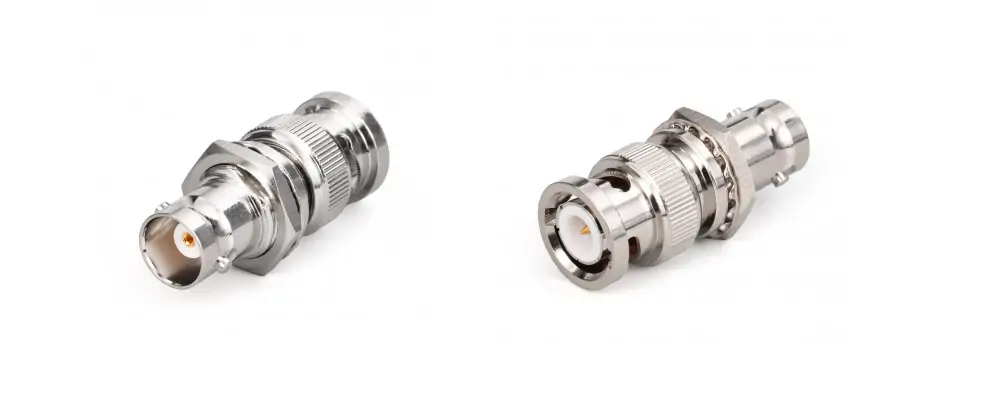
A bnc to bnc adapter can be the difference between a clean radio bench and a last-minute cable reroute. You use it to keep the interface consistent, preserve controlled impedance, and avoid unnecessary rework when your rack, panel, or test setup changes. In current BNC product families, the connector system uses a bayonet coupling interface and is offered in both 50 Ω and 75 Ω versions; depending on the family, published performance reaches 4 GHz for standard 50 Ω RF use and 12 GHz for 75 Ω broadcast or video applications. [1]
If you work in RF, microwave, electronics, or bench test integration, the right adapter is not just a small accessory. It affects signal stability, panel fit, service speed, and how often you will need to touch the same port again. That is why buyers compare not only a bnc male to bnc female adapter or bnc female to female adapter, but also the exact body style, impedance, and mating life before they place an order. [2]
You should think of a bnc to bnc adapter as part of the RF chain, not as a spare part. The University of Washington RF laboratory notes that routing RF and microwave signals with minimum loss and minimum reflections requires controlled impedance lines and connectors. Rohde & Schwarz also explains that VSWR = 1 means optimum power transmission without reflection, while higher values point to matching problems. [5]
That matters because a loose or mismatched connection can look like a system fault when the real problem is the connector interface. Keysight’s measurement guidance adds that a return loss of 15 dB or more and a VSWR of 1.5:1 or better are signs of good impedance matching and low signal loss. For a radio project, that is exactly why the adapter you choose should match the system first and the geometry second. [4]
Many radio racks and embedded RF systems leave very little clearance around connectors. A straight cable may introduce bending stress or interfere with nearby modules. In these situations, a right-angle adapter or compact inline coupler can simplify cable management.
According to L-com’s RF adapter documentation, right-angle BNC adapters are commonly used to solve orientation and enclosure clearance problems in coaxial systems. This is especially useful when you are working with SDR platforms, VNA test setups, RF amplifiers, or portable radio systems.
Repeated mating cycles slowly damage expensive instrument ports. Instead of plugging directly into the analyzer or radio every day, engineers often install a sacrificial adapter.
For example, a bnc female to female adapter can act as a connector saver between a test cable and an oscilloscope input. Over time, replacing a low-cost adapter is much cheaper than replacing the original instrument connector.
| Adapter Type | Typical Use | Frequency Range | Main Benefit |
|---|---|---|---|
| bnc female to female adapter | Cable extension | DC to 4 GHz | Simple inline expansion |
| bnc male to male adapter | Female port connection | DC to 4 GHz | Connector saver |
| bnc male to bnc female adapter | Gender conversion | DC to 4 GHz | Flexible integration |
| Right-angle BNC adapter | Tight enclosures | DC to 4 GHz | Reduced cable stress |
| 75 Ω BNC adapter | Video systems | Up to 12 GHz | Broadcast compatibility |
Samtec documentation shows that many 50 Ω BNC products operate up to 4 GHz, while selected 75 Ω video versions can reach 12 GHz.
A small SDR development team needed to extend a receiver input without replacing the existing coax cable assembly. A bnc female to female adapter solved the issue immediately and reduced setup time by nearly 40 minutes during testing.Pasternack lists several inline BNC adapters rated to 4 GHz specifically for RF measurement and laboratory applications.
An older broadcast monitoring system required multiple bnc male to bnc male adapter connections to interface with legacy rack equipment. Using standard 50 Ω adapters introduced mismatch concerns.The engineering team switched to dedicated 75 Ω adapters to preserve signal consistency across the monitoring path.
In a compact mobile radio enclosure, the cable bend radius was too aggressive near the RF module. A right-angle bnc to bnc adapter reduced cable strain and prevented intermittent signal loss during vibration testing.Amphenol RF specifically highlights right-angle and bulkhead BNC solutions for constrained RF environments.
Choosing the wrong adapter creates more problems than it solves. You should evaluate impedance, geometry, and service life before ordering.
Always confirm whether your system is 50 Ω or 75 Ω. Mixing them increases VSWR and can introduce signal reflections.According to RF connector guidelines from the University of Washington RF Laboratory, impedance discontinuities directly affect signal integrity in microwave systems [3].
Straight adapters are best for inline routing. Right-angle adapters reduce cable stress in small enclosures. Bulkhead versions improve panel installation stability.Do not choose geometry based only on appearance. Cable strain and connector access matter more in long-term deployments.
If the connection will be mated frequently, use a connector saver or reinforced adapter body. Brass bodies with gold plating typically provide better durability than lower-cost commercial alternatives.This is especially important when selecting parts from a bnc adapter female to female manufacturer or a bnc adapter male to female factory for large production runs.
Low-cost adapters often use inconsistent plating thickness or poor center pin tolerances. This can create intermittent RF behavior that is difficult to diagnose later.
Not every BNC adapter is designed for microwave frequencies. A low-frequency adapter may work physically but fail electrically in a higher-frequency RF chain.
Many RF failures come from mechanical stress rather than electrical design. Choosing the right body orientation helps extend cable life significantly.
A high-quality bnc to bnc adapter is more than a simple RF accessory. It helps you protect expensive equipment, simplify integration, improve cable routing, and maintain stable RF performance across radio projects.Whether you need a bnc male to bnc female adapter, a bnc female to female coaxial adapter, or a bnc adapter male to female manufacturer for larger production work, the key is selecting the correct impedance, geometry, and durability level for the real operating environment.When you choose the adapter based on actual RF conditions instead of only connector shape, you reduce troubleshooting time, improve installation quality, and create a more reliable radio system overall.
Coaxial Cable Assembly
Microwave Test Cable
Coaxial RF Connector
Coaxial RF Adapter
Coaxial RF Termination
Coaxial RF Test Probe
Coaxial RF Attenuator
RF Switches
Rotary Joints
RF Circulators
Coaxial RF Power Dividers
RF Couplers
RF Filters
Please send a message to us and we will reply to you ASAP, thank you.