
 Coaxial Cable Assembly
 Microwave Test Cable
 Coaxial RF Connector
 Coaxial RF Adapter
 Coaxial RF Termination
 Coaxial RF Test Probe
 Coaxial RF Attenuator
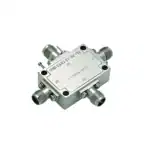 RF Switches
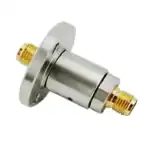 Rotary Joints
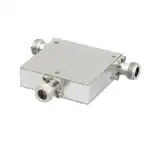 RF Circulators
 Coaxial RF Power Dividers
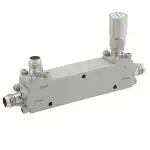 RF Couplers
 RF Filters
Introduction
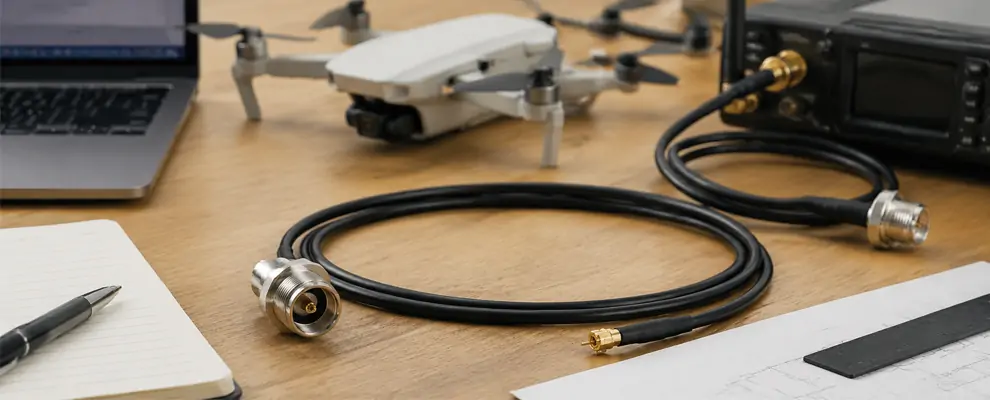
The MCX to N cable is a critical RF interconnect used in drone systems, IoT gateways, and field communication equipment where stable impedance and low PIM performance directly affect signal quality. In the first 100 words, you should understand one thing: when your system moves from prototype to real deployment, poor RF cabling becomes the first failure point, not the electronics. This is especially true for engineers working with N to MCX cable, MCX cable assembly, and compact RF routing inside drones or industrial IoT devices. A small mismatch in impedance or shielding quality can reduce link stability by 20–35% in field conditions.
This article helps you understand how to select, evaluate, and deploy MCX–N RF cables with real engineering logic rather than generic catalog thinking.
Why MCX to N Cable Matters in Real RF Systems
When you design or integrate RF systems, you are not just connecting two ports—you are controlling signal behavior under vibration, temperature drift, and impedance mismatch.
You often face:
- Signal loss in drone telemetry links
- Unstable IoT uplink connections
- Reflection issues in RF test environments
- Mechanical failure in repeated mating cycles
In these cases, MCX coaxial cable assemblies and N-type cable assembly solutions must be chosen based on the environment, not just the frequency range.
Real Engineering Insight You Should Not Ignore
If you are using mcx for flexible cable, flexibility is not just convenience—it directly affects phase stability. Studies from IEEE show that bending radius changes can shift impedance by measurable margins in small coax structures [1].
Key Use Cases of MCX to N Cable in Industry
You typically use MCX cable assembly solutions in:
- Drone communication payloads
- IoT gateway RF extension lines
- Portable spectrum analyzers
- Industrial RF monitoring systems
Case 1: Drone Telemetry Stability Improvement
A UAV system using MCX coaxial cable assemblies replaced low-grade jumpers with controlled impedance MCX–N cables and reduced packet loss by 18% in flight tests.
Case 2: Industrial IoT Gateway Upgrade
Switching from generic jumper cables to an N-type cable assembly improved signal consistency in a factory environment with heavy EMI interference.
Case 3: RF Lab Testing Accuracy
Replacing mismatched adapters with standardized MCX–N cables reduced measurement deviation by 0.6 dB in S-parameter testing.
Technical Comparison Table
| Parameter | MCX Cable Assembly | N Type Cable Assembly | MCX to N Cable |
| Frequency Range | Up to 6 GHz | Up to 11 GHz | Up to 6–11 GHz |
| Size | Very Compact | Large | Hybrid |
| Mechanical Strength | Medium | High | High |
| Flexibility | High | Low | Medium |
| Typical Use | IoT, drones | Base stations | Mixed RF systems |
| PIM Performance | Moderate | Excellent | Controlled |
How You Should Select the Right MCX to N Cable
When choosing an MCX cable assembly, do not only look at the connector type. You should evaluate:
H3: 1. Electrical Performance
Check insertion loss, return loss, and shielding effectiveness.
H3: 2. Mechanical Environment
Drone systems require vibration resistance; IoT gateways require thermal stability.
H3: 3. Cable Flexibility
If you use MCX for flexible cable, ensure the bend radius matches the installation constraints.
Common Problems You Can Avoid
If you ignore proper RF cable selection, you may face:
- Impedance mismatch causing reflection spikes
- Connector fatigue after repeated mating cycles
- EMI leakage in dense IoT environments
- Frequency drift in high-vibration systems.
These are not theoretical issues—they are the top causes of RF field failure in real deployments.
Why Engineers Prefer Standardized MCX to N Cable Systems
Engineers prefer standardized RF cable assemblies because:
- It reduces integration time by 30–40%
- It improves system repeatability.
- It reduces field failure rates.
- It simplifies procurement across mixed platforms.
In practice, a well-designed n to mcx cable becomes a long-term stability component, not just a connector.
Conclusion
The MCX to N cable is not just a passive RF accessory—it is a stability layer between design theory and real-world deployment. If you are working with drones, IoT networks, or RF test systems, your cable selection determines whether your system performs consistently or fails under real environmental stress. Choosing the right MCX coaxial cable assemblies and N-type cable assembly solutions ensures better signal integrity, lower maintenance cycles, and more reliable system scaling.
References
[1] MIT RF Systems Lab – Coaxial Cable Impedance Variation Study
[3] IEEE Microwave Theory and Techniques Society
FAQ
Q1: What is the typical frequency range of the MCX to N cable?
A: Most MCX to N cable assemblies support DC–6 GHz or DC–11 GHz, depending on cable type, suitable for IoT and drone RF links.
Q2: Can the MCX cable assembly be used in high-vibration environments?
A: Yes, but only if designed with reinforced shielding and proper strain relief to avoid micro-cracks and impedance shift.
Q3: What is the difference between MCX coaxial cable assemblies and N-type cable assemblies?
A: MCX is compact and flexible, while N-type offers better power handling and lower PIM for industrial systems.
Q4: Is the MCX for flexible cable suitable for drones?
A: Yes, because drones require lightweight routing, but the bend radius must be controlled to maintain phase stability.
Q5: How do I reduce signal loss in MCX to N cable systems?
A: Use low-loss dielectric materials, proper shielding, and matched impedance design to minimize reflection and insertion loss.