
 Coaxial Cable Assembly
 Microwave Test Cable
 Coaxial RF Connector
 Coaxial RF Adapter
 Coaxial RF Termination
 Coaxial RF Test Probe
 Coaxial RF Attenuator
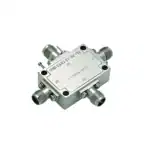 RF Switches
 Rotary Joints
 RF Circulators
 Coaxial RF Power Dividers
 RF Couplers
 RF Filters
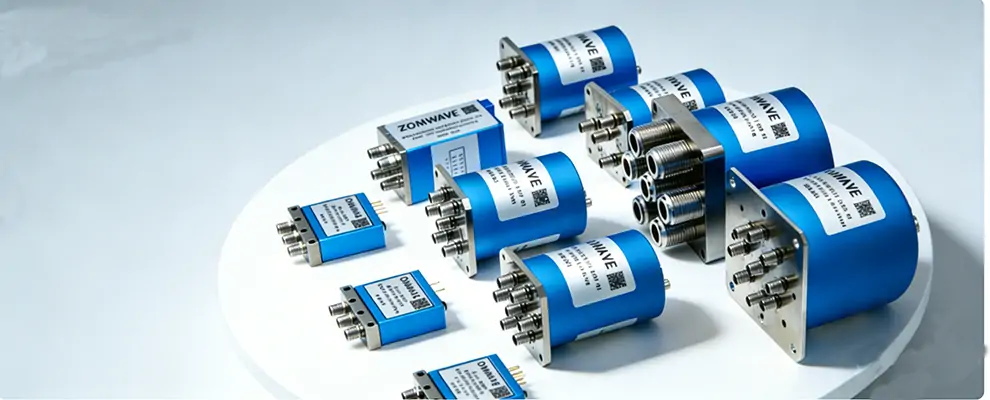
When selecting a coaxial switch for your RF system, one of the most important decisions you’ll face is whether to go with a Terminated (Absorptive) or Non-Terminated (Reflective) design.
The choice may seem technical, but it boils down to a simple question:
What happens to signals that reach unused ports?
Let’s explore the differences, advantages, and ideal applications for each type—so you can make the right call with confidence.
What’s the Difference?
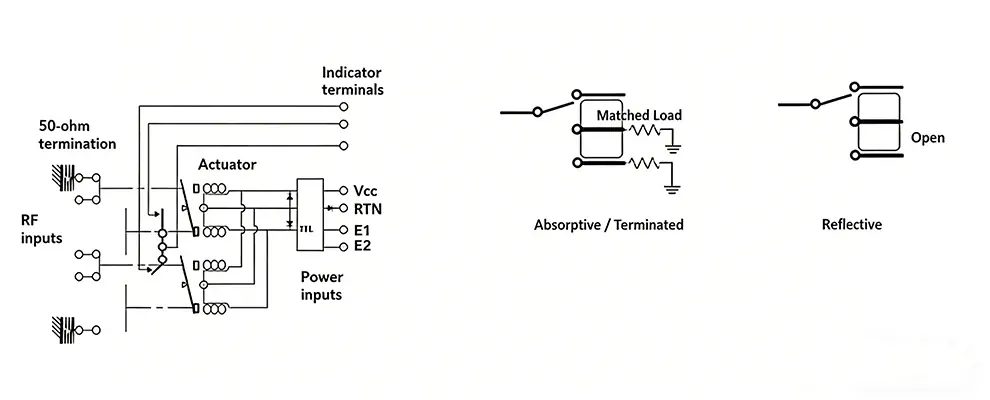
Terminated Coaxial Switches (also called absorptive or obstructive switches) have built-in impedance matching—typically 50Ω—at every port. When a port is not selected, it automatically connects to this internal load, absorbing any signal that reaches it. Nothing bounces back.
Non-Terminated Coaxial Switches (also called reflective switches) leave unused ports open. Signals that arrive at an unselected port have nowhere to go but back—they reflect toward the source.
This fundamental difference shapes everything else about how these switches perform in real-world applications.
Terminated Switches: The Signal Integrity Champion
How they work:
Inside a Terminated switch, each output port has a 50Ω load connected to it. When the switch routes signal to one port, all other ports are terminated. This means every port presents a consistent, predictable impedance regardless of which path is active.
Key advantages:
- Eliminates signal reflectionsthat can distort measurements
- Maintains consistent impedanceacross all ports
- Protects sensitive equipmentfrom reflected power
- Ideal for precision applicationswhere accuracy matters
Best suited for:
- Automated test equipment (ATE) and measurement systems
- Laboratory setups where measurement repeatability is critical
- Systems with sensitive receivers that could be damaged by reflections
- Multi-instrument switching where signal purity is paramount
Trade-offs:
Terminated switches typically have slightly higher insertion loss and come at a higher price point due to the additional internal components.
Non-Terminated Switches: The Flexible Performer
How they work:
Non-Terminated switches keep the signal path simple. Unused ports are left open, meaning they present a high impedance. Signals reaching these ports reflect toward the source instead of being absorbed.
Key advantages:
- Lower insertion lossdue to simpler internal construction
- More affordablethan terminated alternatives
- Flexible termination options—add external loads as needed
- Can handle higher powerby using external terminations rated for your specific requirements
Best suited for:
- Transmit/Receive (T/R) switching where reflections are acceptable
- Antenna switching systems
- High-power broadcast applications
- Prototype and development environments where flexibility is key
- Systems where cost is a primary consideration
Trade-offs:
Signal reflections can cause measurement errors in sensitive applications. The impedance environment changes depending on which port is active.
The RF Switch with Terminated vs. Non-Terminated:
Feature | Terminated (Absorptive) | Non-Terminated (Reflective) |
Unused Ports | Internally terminated to 50Ω | Open circuit / high impedance |
Signal Reflections | Absorbed | Reflected |
Insertion Loss | Slightly higher | Slightly lower |
Cost | Higher | Lower |
Power Handling | Limited by internal loads | Can use external high-power loads |
Impedance Consistency | Consistent across all ports | Varies with switch state |
View the schematic diagrams below for additional information:
How to Make the Right Choice
Still unsure which path to take? Ask yourself these three questions:
- What’s connected to the switch?
- If you’re routing signals to sensitive test equipment or receivers → chooseTerminated
- If you’reRF switches between antennas or transmitters → Non-Terminated may work well
- Can your system tolerate reflections?
- For precision measurements where accuracy is critical → chooseTerminated
- For applications where reflected signals won’t cause problems → Non-Terminated is fine
- What’s your priority—cost or performance?
- If budget allows and signal integrity matters most → choose Terminated
- If cost is a constraint and you can manage reflections →Non-Terminated offers great value
Real-World Examples
Example 1: Production Test Lab
A manufacturer testing RF modules needs to route a signal generator to multiple devices under test. Measurement accuracy is critical. They choose a SP6T switch with Terminated to ensure no reflections corrupt their test results.
Example 2: Base Station T/R Module
A telecom system needs to switch between transmit and receive paths sharing a single antenna. The application can tolerate some reflections, and minimizing insertion loss is the priority. They choose a SPDT with Non-Terminated switch.
The conclusion is as follows
Neither terminated nor non-terminated switches are universally “better”—the right choice depends entirely on your application.
Choose Terminated when signal integrity, measurement accuracy, and protecting sensitive equipment are your top priorities.
Choose Non-Terminated when insertion loss matters most, your system can tolerate reflections, or you need flexibility with termination options.
Still have questions about which switch fits your system? Our engineering team is ready to help you make the right choice.