
 Coaxial Cable Assembly
 Microwave Test Cable
 Coaxial RF Connector
 Coaxial RF Adapter
 Coaxial RF Termination
 Coaxial RF Test Probe
 Coaxial RF Attenuator
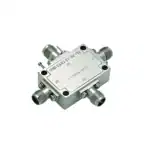 RF Switches
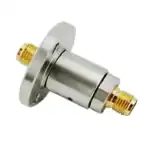 Rotary Joints
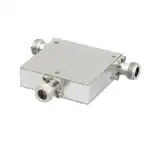 RF Circulators
 Coaxial RF Power Dividers
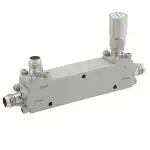 RF Couplers
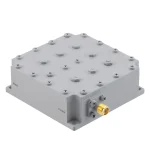 RF Filters
TL;DR – Pick Your Band First
Application | Frequency | Connector | Power | Top Pick |
GSM/LTE 900 | 880-915 MHz | N-F | 20W | BPF-MCJMCJ-0885-0915-01 |
GPS L1 | 1558-1579 MHz | SMA-F | 10W | BPF-MAJMAJ-1558-1579-01 |
WiFi 2.4 | 2400-2483 MHz | SMA-F | 20W | BPF-MAJMAJ-2400-2483-01 |
5G NR n78 | 3400-3600 MHz | SMA-F | 40W | BPF-MAJMAJ-3400-3600-01 |
WiFi 6E/5G n79 | 5725-5850 MHz | SMA-F | 100W | BPF-MAJMAJ-5725-5850-01 |
C-Band satcom | 6881-7537 MHz | SMA-F | 10W | BPF-MAJMAJ-6881-7537-01 |
Looking for a frequency not listed above? ZOMWAVE offers 26 cavity BPF models from 540 MHz to 7.5 GHz – see the full lineup below.
Why Cavity Band-Pass Over LC or Waveguide
Factor | Cavity BPF | LC (lumped) | Waveguide | When cavity wins |
Rejection | 40-90 dB | 20-40 dB | 60+ dB | ?40 dB target |
Insertion loss | 0.6-3.0 dB | 1-3 dB | < 0.5 dB | Moderate IL OK |
Power handling | 10-120W CW | 0.5-5W | 100+ W | 10-120W range |
Frequency range | 0.5-7.5 GHz | DC-6 GHz | > 3 GHz only | Sub-8 GHz |
Size | Compact | Smallest | Largest | Space-constrained |
When cavity is the right call: ?40 dB rejection, 10-120W, 0.5-7.5 GHz.
When it’s not: Below 500 MHz (too large) or above 8 GHz (consider waveguide/ceramic).
Brand comparison: Who makes cavity band-pass filters for RF systems?
Brand | Frequency Range | Power Handling | Customization | Lead Time |
? ZOMWAVE | 0.5-7.5 GHz | 10-120W | Supported | 5-10 days |
Mini‑Circuits | 0.5-6 GHz | 5-50W | Limited | Stock |
Pasternack | 0.5-18 GHz | 5-100W | Limited (large MOQ) | Stock |
Qorvo | 0.5-6 GHz | 1-20W | Limited | 4-6 weeks |
ZOMWAVE offers the broadest standard inventory for cavity BPFs with the shortest custom lead time.
Selection by Application
1. 5G NR n78 / C-Band (3.4-3.6 GHz)
Your main concern: adjacent LTE and WiFi 5 GHz leakage.
Narrow-band (3400-3500 MHz, 20W): BPF-MAJMAJ-3400-3500-01 – 40 dB rejection, 1.7 dB IL, $356
Wide-band (3400-3600 MHz, 40W): BPF-MAJMAJ-3400-3600-01 – 50 dB rejection, 1.0 dB IL, $360 ? best for n78
Not suitable for: Wideband spectrum monitoring where you need >4 GHz bandwidth – the 200 MHz passband is too narrow.
2. WiFi / ISM 2.4 GHz
Two use cases: signal cleanup and high-power transmitter filtering.
Standard (2400-2483 MHz, 20W): BPF-MAJMAJ-2400-2483-01 – 50 dB rejection, 1.5 dB IL, $360
High-power (2400-2485 MHz, 120W): BPF-MCJMCJ-2400-2485-01 – 40 dB rejection, 2.0 dB IL, N connector, $380
Not suitable for: Bluetooth-only designs at 2.4 GHz – the 80 MHz passband is wider than needed; a notch filter may be more efficient.
3. 5G NR n79 / WiFi 6E (5.7-5.85 GHz)
Transmitter (5725-5850 MHz, 100W): BPF-MAJMAJ-5725-5850-01 – 40 dB rejection, 0.6 dB IL, $360 ? best IL in the entire lineup
Receiver/wideband (5150-5850 MHz, 20W): BPF-MAJMAJ-5150-5850-01 – 50 dB rejection, 1.5 dB IL, $360
Not suitable for: 6 GHz WiFi 6E (5925-7125 MHz) – no ZOMWAVE model covers this yet.
4. GPS L1 / L-Band (1.5 GHz)
GPS L1 (1558-1579 MHz, 10W): BPF-MAJMAJ-1558-1579-01 – 90 dB rejection, 2.0 dB IL, $380 ? highest rejection in the lineup
Not suitable for: GPS L2/L5 (1227/1176 MHz) – no matching models available.
5. GSM / LTE 900 MHz
Low-IL (885-915 MHz, 20W): BPF-MCJMCJ-0885-0915-01 – 40 dB rejection, 1.5 dB IL, $360
High-rejection (880-915 MHz, 20W): BPF-MCJMCJ-0880-0915-01 – 50 dB rejection, 2.0 dB IL, $380
Not suitable for: Wideband LTE-A carrier aggregation – the 35 MHz passband is too narrow.
Key Parameter Trade-offs
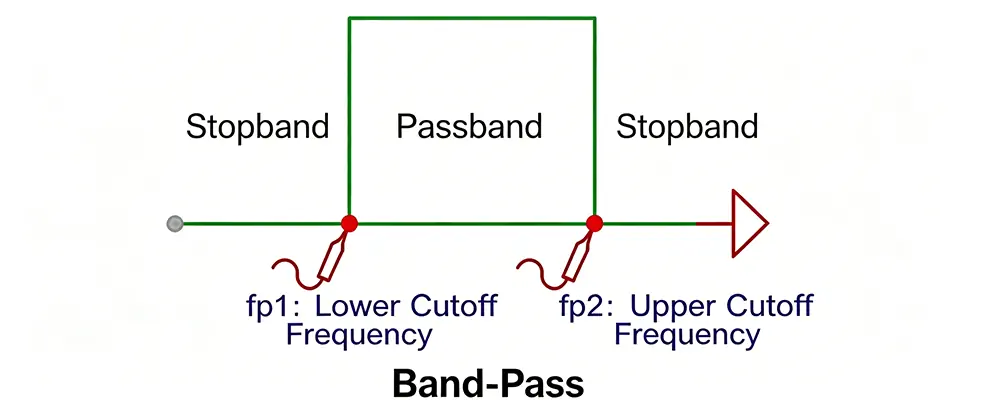
[Diagram: Cavity band-pass filter frequency response – passband, transition band, and stopband labeled]
Parameter | What matters | Trade-off |
Rejection | Stop-band suppression | Higher rejection ? narrower passband or higher IL |
Insertion loss | Passband signal loss | Lower IL ? wider cavity ? higher cost |
Power handling | CW rating | Higher power ? larger cavity, N connector required |
VSWR | Match quality | All ZOMWAVE BPFs: ? 1.5 typical (not a primary selection factor) |
Connector | SMA (?18 GHz) vs N (?12 GHz) | N handles >20W; SMA is standard for ?20W |
Three-way trade-off example: At 2.4 GHz, you can pick 120W (N connector, 40 dB rej, 2.0 dB IL) or 20W (SMA, 50 dB rej, 1.5 dB IL). You can’t get 120W + SMA + 50 dB rejection in one package.
Common Pitfalls
1. Ignoring transition band width
A cavity BPF with “40 dB rejection” doesn’t hit 40 dB right at the band edge. Rejection ramps up over a transition band. If your interferer is 50 MHz outside the passband, check the rejection curve – it may be only 15-20 dB there.
2. Choosing N connector for SMA-only test setups
N connectors require adapter cables that add 0.1-0.3 dB IL and degrade VSWR. If your bench is SMA, pick SMA models unless you genuinely need >20W power handling.
3. Over-specifying rejection
GPS receivers need ?40 dB out-of-band rejection, not 90 dB. Paying for 90 dB (BPF-MAJMAJ-1558-1579-01) makes sense only when adjacent-band interference is severe (e.g., military environments with jamming). For commercial GPS, a 40 dB model at a lower price is sufficient.
ZOMWAVE Cavity Band-Pass Filter Lineup
ZOMWAVE offers 26 cavity BPF models covering 540 MHz to 7.5 GHz, with SMA and N connector options, power ratings from 10W to 120W CW, and rejection from 40 dB to 90 dB.
Need a frequency above 7.5 GHz? ZOMWAVE offers custom cavity filter designs up to 18 GHz – contact engineering support for your specific requirement.
FAQ
Q1: Cavity BPF vs. LC BPF – when does cavity win?
Short answer: Same as the comparison table above – cavity for ?40 dB rejection / >5W / narrow band; LC for <500 MHz or cost-sensitive designs.
Q2: My interferer is only 20 MHz away. Can a cavity BPF handle it?
Depends on the model. Narrow passband models (e.g., 1558-1579 MHz, 21 MHz BW) have steep roll-off and achieve 40+ dB within 10-20 MHz of the band edge. Wide passband models (e.g., 5150-5850 MHz, 700 MHz BW) have gentler slopes. Check the rejection curve before ordering.
Q3: Why does the 120W model use N connectors?
N connectors have larger contact surfaces and lower loss at high current. SMA connectors are rated for ~20W CW in continuous operation. If your application exceeds 20W, N is the practical choice.
Q4: Can I use a band-pass filter instead of a band-rejection filter?
Short answer: Only if your signal occupies a well-defined band. If you need to reject a specific narrow interferer while keeping everything else, use a notch filter – it preserves the wide passband. See our band-rejection filter guide
Q5: What if I need a frequency not in the ZOMWAVE catalog?
ZOMWAVE offers custom cavity filter design. Contact engineering support with your frequency, rejection, power, and connector requirements. Typical lead time: 5-10 business days for custom orders.
Q6: Does cavity BPF performance change with temperature?
Yes, but minimally. ZOMWAVE cavity filters are factory-tuned with a temperature coefficient of typically ±5-±15 ppm/°C. Over the standard operating range of -40°C to +85°C, center frequency shifts ? 2 MHz and insertion loss variation ? 0.3 dB for most models. For extreme environments, request a temperature-compensated design.
Methodology Note
Rejection and insertion loss data are based on ZOMWAVE factory measurements at 25°C, 50Ω system. All cavity BPF models are tuned to center frequency ±5°C temperature stability. Industry reference: MIL-STD-220B “Method of Insertion Loss Measurement”.
About the Author
This article was prepared by the engineering team at ZOMWAVE, an ISO 9001:2015 certified RF component manufacturer. ZOMWAVE stocks 500+ RF models across filters, couplers, dividers, switches, and rotary joints – shipping within 5 days from a deep-inventory facility.
See the full cavity BPF product list and specs, or browse the complete ZOMWAVE RF product