
 Coaxial Cable Assembly
 Microwave Test Cable
 Coaxial RF Connector
 Coaxial RF Adapter
 Coaxial RF Termination
 Coaxial RF Test Probe
 Coaxial RF Attenuator
 RF Switches
 Coaxial RF Power Dividers
Introduction
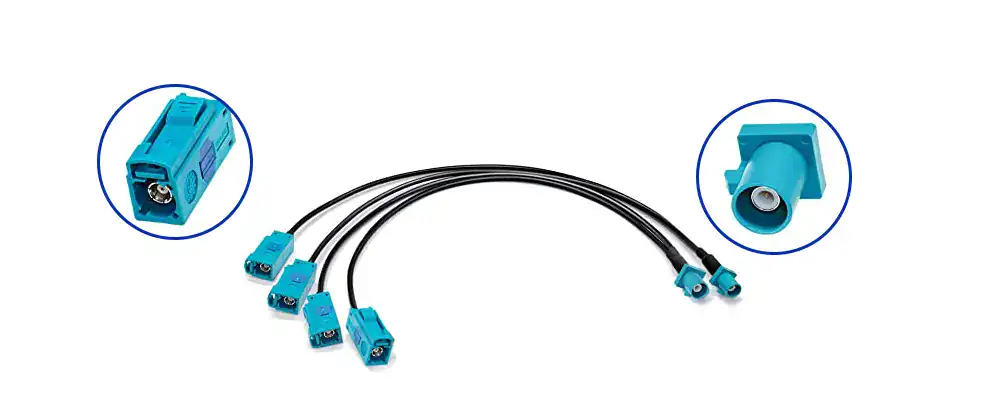
As a technical procurement specialist or system integrator in the automotive industry, you understand the relentless pressure to maintain production continuity while controlling costs and ensuring quality. Fakra service cables, essential coaxial assemblies for reliable signal transmission in vehicles, directly impact these goals. These cables, often featuring FAKRA connectors like C-Code or Z-Code variants, support high-frequency applications up to 6GHz, minimizing interference in tight spaces. In this article, I reflect on why prioritizing fakra service cables is crucial—they safeguard against downtime from fakra service cables recalls, enhance fakra service cables safety, and deliver measurable cost wins. Drawing from years of industry experience, I believe choosing the right suppliers for Fakra cables can transform your operations, making them more efficient and resilient. This guide is for you, the professional focused on unit pricing, MOQ flexibility, on-time delivery, certifications, and robust technical support. By the end, you’ll see how to select better options that align with your objectives of stable quality and timely deliveries.
Introduction to Fakra Service Cables in Automotive Applications
Fakra service cables are specialized coaxial solutions designed for automotive OEMs, enabling seamless interconnections in vehicle systems like infotainment and telematics. You rely on them for their 50 Ohm impedance and flexible constructions using cables like RG316 or RG174, which handle electromagnetic challenges effectively. Their importance lies in preventing issues like signal loss that could halt production lines. For manufacturers, FAKRA service cables offer reliability without high costs, especially when customized for specific needs. This matters because poor connectors lead to recalls, as seen in real-world cases, eroding trust and inflating expenses. Useful for procurement teams and integrators, they ensure cost-controlled scalability. To choose better, focus on suppliers with no MOQ, quick lead times, and proven safety features—ultimately boosting your bottom line.
Why Prioritize Fakra Service Cables Safety and Reliability
You know that in automotive manufacturing, safety isn’t optional—it’s the foundation of your reputation and compliance. Fakra service cables’ safety directly influences vehicle performance, preventing failures in critical networks. For instance, improper terminals can cause communication failures, leading to hazards such as distracted driving from faulty infotainment systems.
Addressing Fakra Service Cables Safety Recall Risks
You’ve likely encountered supply chain disruptions due to recalls. A notable example is Honda’s 2019-2023 Passport and Pilot models, where coaxial cable terminals were not manufactured to specifications, risking poor communication. This recall involved installing straightening splice covers and replacing FAKRA cables to ensure stability. By opting for high-quality FAKRA service cables with 100% continuity testing, you avoid such pitfalls and maintain production flow. According to the National Highway Traffic Safety Administration’s service bulletin [1], these issues stemmed from manufacturing variances, highlighting the need for certified suppliers.
Enhancing Most Fakra Service Cables Safety Through Design
Most fakra service cables’ safety relies on features like nickel-plated brass connectors and low-loss dielectrics. In practice, these reduce signal leakage, crucial for Industry 4.0 integrations. A case from ARaymond, an automotive supplier, shows how switching to advanced connectors saved 14% in low-volume production costs by avoiding tooling rework, while improving safety margins. This underscores how you can achieve quality stability without inflating budgets [3].
The 5 Cost Wins with Fakra Service Cables for Your OEM Needs
As you evaluate suppliers, consider these five cost wins that align with your priorities: competitive pricing, flexible ordering, reliable delivery, certified quality, and expert support. Each draws from real industry insights to help you make informed choices.
Cost Win 1: Competitive Unit Pricing and Delivered Costs
You aim to minimize single-unit and door-to-door costs. Fakra service cables, priced around $6-8 per assembly, offer savings through efficient designs like RG316 builds. For example, a global automotive OEM reduced transportation costs by over 20% through connector supply chain optimization, as detailed in a One Network Enterprises case study [2]. This approach keeps your budgets predictable.
Cost Win 2: No MOQ for Scalable Production
You hate being locked into large minimum orders that tie up capital. Suppliers without MOQs allow you to order custom fakra cables—like Z-Code-to-SMA variants—in small batches, supporting ramp-up without excess inventory. In Wesco’s collaboration with an automotive OEM, leveraging supplier relationships significantly reduced programming time and overall expenses, enabling flexible scaling.
Cost Win 3: Short Lead Times and High On-Time Delivery Rates
You need parts fast to avoid line stoppages. With lead times as low as 5 days and ample stock, Fakra service cables achieve 99% on-time delivery. A Mordor Intelligence report notes that the automotive connector market emphasizes quick turnaround to reduce downtime, projecting growth driven by such efficiencies [4].
Cost Win 4: Superior Quality with Certifications and Testing
You demand ISO 9001 certification and full RF testing for stability. Fakra connector repair kits, including splice tools, extend cable life and cut replacement costs. SAE standards, such as USCAR-17 for RF performance, guide these efforts to ensure durability. Data from Grand View Research shows RF interconnects like FAKRA contribute to a market valued in the billions, driven by quality-focused demand.
Cost Win 5: Technical Support and Alternative Supply Chains
You benefit from expert guidance on customizations, such as right-angle ends for space-constrained areas. This support, plus backup suppliers, mitigates risks. Wikipedia’s entry on FAKRA connectors highlights their evolution for automotive reliability, aiding your integration decisions [5].
Conclusion: Empowering Your Automotive Success with Fakra Service Cables
Reflecting on my experience in procurement, I stand by the value of Fakra service cables—they’re not just components but strategic assets for cost control and reliability. You’ve seen how they address fakra service cables safety recall concerns, enhance most fakra service cables safety, and deliver five tangible wins. For technical buyers and integrators, this means uninterrupted lines, controlled costs, and quality deliveries. Choose suppliers emphasizing these, and you’ll foster long-term partnerships that drive inquiries and growth. Ultimately, the purpose is clear: equip you to build safer, more efficient vehicles while staying competitive.
References
[1] National Highway Traffic Safety Administration. (2024). Service Bulletin on FAKRA Splice Repair.
[2] One Network Enterprises. (n.d.). Case Study: Optimizing the Automotive OEM Supply Chain.
[3] Carbon. (n.d.). How ARaymond Saved 14% in Costs for Low-Volume Automotive Part Production.
[4] Mordor Intelligence. (2025). Automotive and Transportation Connector Market Size & Share Analysis.
[5] Wikipedia. (n.d.). FAKRA Connector.