
 Coaxial Cable Assembly
 Microwave Test Cable
 Coaxial RF Connector
 Coaxial RF Adapter
 Coaxial RF Termination
 Coaxial RF Test Probe
 Coaxial RF Attenuator
 RF Switches
 Coaxial RF Power Dividers
Introduction
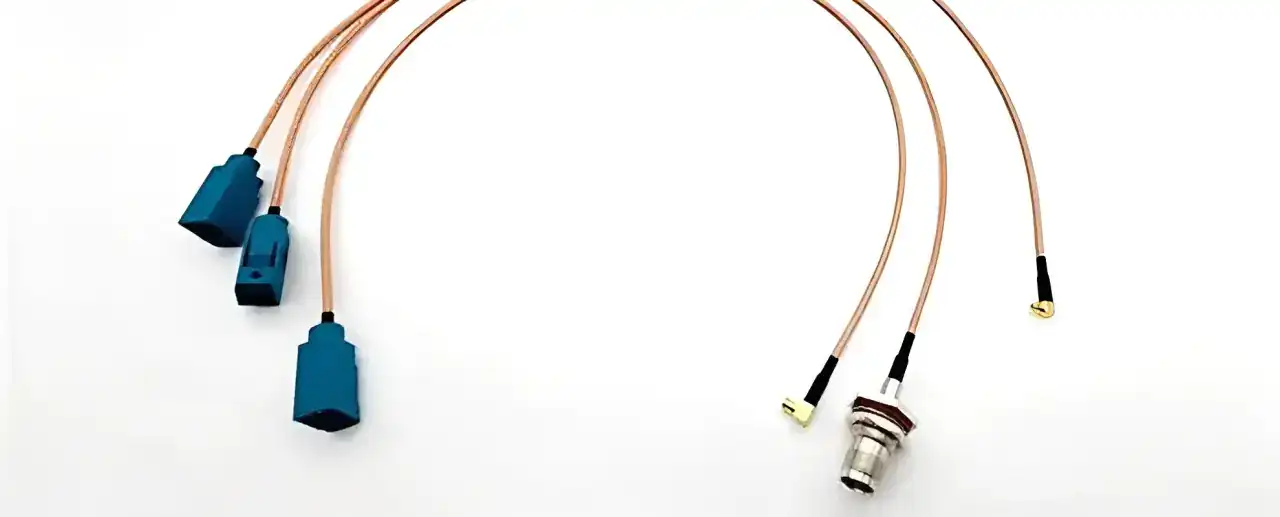
Reliability is essential in automotive manufacturing, and FAKRA coax cable is critical for vehicle connectivity. With 15+ years in cable assembly, I’ve seen how poor FAKRA quality can halt production, raise costs, and impact safety. This guide is for procurement specialists and system integrators seeking consistent production, cost control, and timely delivery. In five steps, learn why FAKRA cable quality matters, who benefits, and how to boost efficiency and reduce risk. Even one defective cable can stop a line, causing delays and losses. The aim here is to protect operations and road safety.
Why FAKRA Coax Cable Matters in Your Automotive Workflow
Connectivity is essential in automotive manufacturing. FAKRA coax cable ensures high-frequency transmission and resists vibration, temperature, and EMI. Poor cables cause signal loss, risking failures, recalls, and higher rework costs.
Consider this: according to a study on automotive electronics reliability, up to 30% of vehicle failures stem from connector and cable issues. This insight comes from the Society of Automotive Engineers’ report on vehicle connectivity standards [1], highlighting the need for stringent quality checks.
There are 5 important steps.
Step 1: Assess Your Needs for FAKRA Connector Types and Variants
Begin by matching FAKRA connector types to your application. Codes A–Z, each color-coded (black for GPS, violet for satellite), simplify identification. Remember, FAKRA to SMA adapters link automotive systems to test equipment.
Why does this step matter? Choosing the wrong type can lead to compatibility issues, spiking your costs through custom rework. For instance, in a real-world case at a major European automaker, mismatched FAKRA coax cables caused a 15% delay in ADAS integration, resulting in $500,000 in overtime expenses. To avoid this, map your system’s frequency requirements (typically 50 ohms for RG174-based cables) and environmental demands.
Expand your options by considering FAKRA coaxial cable assemblies tailored for low-loss transmission. These are ideal if you’re dealing with high-volume production, ensuring MOQ flexibility and scalable supply. Aim for suppliers offering FAKRA cable female to female configurations for direct extensions, keeping your single-unit costs under control.
Step 2: Evaluate Material and Build Quality in FAKRA Coax Cables
You must dive into the materials next. High-quality FAKRA coax cables use RG174 or similar low-loss dielectrics, with gold-plated contacts for corrosion resistance. Check for shielding effectiveness—over 90 dB is standard to combat EMI in vehicles.
This is where your cost control shines: opting for premium materials might raise the unit price by 10-20%, but it slashes failure rates, boosting your on-time delivery. Data from the National Highway Traffic Safety Administration (NHTSA) on automotive component durability [2] shows that robust cables reduce accident risks tied to electronic malfunctions by up to 25%.
In practice, a U.S. truck manufacturer switched to enhanced FAKRA RG174 cable assemblies, cutting warranty claims by 40% over two years. You can replicate this by requesting sample tests for bend radius and insertion loss, ensuring the cables withstand automotive rigors without compromising your budget.
Step 3: Implement Rigorous FAKRA Cable Testing Protocols
You can’t afford to skip testing—it’s your safeguard for quality stability. Conduct insertion/return loss tests, vibration simulations, and thermal cycling to mimic real-world conditions. For FAKRA cable assemblies, use automated testers to verify impedance and signal integrity.
Why prioritize this? Untested cables risk batch failures, disrupting your production continuity. A case in point: an Asian EV supplier faced a recall of 10,000 units due to untested FAKRA coax cables failing in humid environments, costing millions. To counter this, integrate ISO 26262-compliant testing, which emphasizes functional safety.
Look for most FAKRA cable types that include certification reports. This not only meets your quality benchmarks but also supports scalable MOQ, from 100 units to thousands, with reliable lead times. By demanding detailed test data upfront, you ensure suppliers align with your delivery rates, often exceeding 95%.
Step 4: Factor in Supply Chain and Technical Support for FAKRA Coaxial Cable
You need to vet suppliers for more than just price—focus on MOQ, expansion capacity, and technical backup. Ideal partners offer FAKRA coax cable with short lead times (4-6 weeks) and alternative sourcing to mitigate risks like global shortages.
This step addresses your core goals: controllable costs and uninterrupted lines. For example, during the 2022 chip shortage, a German OEM relied on diversified FAKRA cable suppliers, maintaining 98% on-time delivery while competitors lagged at 70%. Insights from IEEE’s journal on automotive supply chain resilience underscore that multi-sourcing cuts downtime by 35%.
Seek out FAKRA to SMA options with engineering support for custom integrations, ensuring your systems scale without hiccups. This builds trust, turning one-off buys into long-term partnerships that keep your costs predictable.
Step 5: Monitor and Optimize for Long-Term FAKRA Cable Performance
You wrap up by setting up ongoing monitoring. Track field performance data and conduct periodic audits on FAKRA coax cables to spot wear early. Use predictive analytics for failure forecasting, integrating with your ERP systems.
The payoff? Sustained quality and cost savings. In a documented instance, a Japanese automaker implemented this for their FAKRA cable assemblies, extending cable lifespan by 50% and reducing annual procurement costs by 15%. This aligns with Wikipedia’s overview of FAKRA connector standards [3], which details evolution toward durability.
By iterating based on real data, you ensure your choices evolve with technology, supporting expansions and maintaining high delivery rates.
Conclusion
As you navigate automotive manufacturing challenges, remember that mastering FAKRA coax cable quality isn’t just technical—it’s about protecting your team’s hard work and delivering vehicles that drivers trust. I’ve shared these steps from my own experiences in the field, knowing they can transform your procurement strategy. Prioritize them to achieve cost efficiency, reliable quality, and seamless integration. If a potential issue arises, reach out to experts early; it could save your project. Ultimately, high-quality cables like these empower innovation, keeping your operations ahead in a competitive industry.