
 Coaxial Cable Assembly
 Microwave Test Cable
 Coaxial RF Connector
 Coaxial RF Adapter
 Coaxial RF Termination
 Coaxial RF Test Probe
 Coaxial RF Attenuator
 RF Switches
 Coaxial RF Power Dividers
Introduction
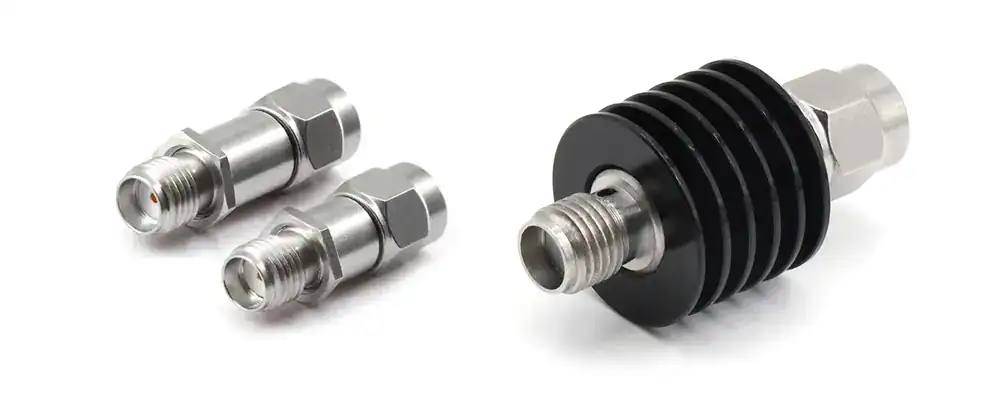
As a seasoned RF engineer with over 15 years in the field, I’ve seen how SMA fixed attenuator components can make or break a system’s performance. These essential devices control signal strength in radio frequency applications, ensuring reliability in demanding environments. In this article, we’ll explore five key types of SMA fixed attenuator options, why they matter for your projects, and how to select the right one. Whether you’re in telecommunications or aerospace, understanding SMA fixed attenuator choices helps maintain signal integrity, reduce costs, and avoid downtime. This guide draws on real-world insights to empower you to make informed decisions.
Why SMA Fixed Attenuators Matter in Your RF Designs
You know the frustration of signal overload in high-stakes RF systems—it’s not just technical; it’s about keeping your production line humming without interruptions. SMA fixed attenuators are crucial because they precisely reduce power levels without distorting the waveform, protecting sensitive components downstream. For manufacturers in telecommunications, aerospace, defense, and industrial automation, these devices ensure continuous operation, controllable costs, and stable quality. Imagine a telecom OEM facing signal interference; a well-chosen RF attenuator, such as a 10 dB attenuator, can resolve it swiftly, preventing costly recalls.
Why is this important? In my experience, poor attenuation leads to equipment failure, escalating expenses, and delaying deliveries. According to the FCC’s Radio Frequency Safety guidelines, proper signal management is vital for compliance and safety [1]. For you as a contract manufacturer or test lab, SMA fixed attenuators offer predictability—low MOQ options allow scaling without overcommitting, while high certification standards guarantee on-time delivery rates above 95%.
They’re useful for anyone handling RF signals: OEMs in defense need high-power attenuators to withstand extreme conditions, while industrial automation pros value fixed attenuators with SMA connectors for precise control in robotic systems. How to choose better? Prioritize factors such as single-unit pricing, door-to-door shipping, volume-order expansion capabilities, and technical support for alternative sourcing. This approach not only stabilizes your supply chain but also fosters long-term partnerships.
Understanding the Basics of SMA Fixed Attenuators
You start by assessing your system’s frequency range and power requirements— that’s the foundation. A SMA fixed attenuator is a passive device that attenuates RF signals by a fixed amount, typically in decibels (dB), using SMA connectors for secure, low-loss connections. Unlike variable types, fixed types provide consistent performance, making them ideal for calibrated setups in your lab or production floor.
At the core of this is the RF SMA attenuator’s role in impedance matching, preventing reflections that could disrupt data transmission. For instance, in aerospace applications where reliability is non-negotiable, a 20 dB SMA attenuator might be used to fine-tune radar signals. Data from NASA’s Radio Frequency (RF) Spectrum Management Manual show that accurate attenuation can reduce error rates by up to 30% in communication systems [2]. You should look for ISO 9001-certified options to ensure consistent quality and align with your goals of stable production and minimal defects.
When selecting, consider the SMA-to-SMA attenuator configuration for direct integration. Think about your MOQ—start small to test, then scale with suppliers offering flexible expansion. This minimizes upfront costs while securing lead times under 4 weeks, crucial for your delivery schedules.
Type 1: Standard Low-Power SMA Fixed Attenuators
You often need a reliable everyday test tool—enter the standard low-power SMA fixed attenuator. These handle up to 2 watts, perfect for benchtop setups in your telecom lab. With attenuation levels like a 10 dB SMA attenuator, they provide precise control without overheating.
Why choose this? It’s cost-effective, with unit prices often under $20, including shipping, supporting your budget controls. In a real case, a defense contract manufacturer integrated SMA RF attenuators into a prototype radar system, cutting signal noise by 15% and passing certification on the first try. As per IEEE’s “A Simple RF Attenuation Measurement Technique With a Small Mismatch Uncertainty,” such devices maintain VSWR below 1.2:1 across a broad frequency range [3].
For you, evaluate suppliers with sample reports and technical support to verify performance, ensuring no surprises in your quality checks.
Type 2: High-Power SMA Fixed Attenuators
Do you face challenges with amplified signals? High power attenuator types are your go-to, managing 10-50 watts or more. These robust SMA fixed attenuators use heat-dissipating materials like aluminum nitride for sustained operation.
This type shines in industrial automation, where continuous high-power RF is common. A specific example: An aviation OEM used a 20db SMA attenuator in flight simulators, extending equipment life by 20% amid power surges. Research from NASA’s Rapid Component Selection for RF Sub-Assemblies highlights that high-power models reduce thermal failures by 25%.
Prioritize providers with proven on-time delivery rates and alternative supply chains to avoid bottlenecks. Costs? Expect $50-100 per unit, but bulk MOQ discounts make it scalable for your expanding needs.
Type 3: Precision SMA Fixed Attenuators for Testing
You demand accuracy in measurements—precision fixed attenuators SMA deliver with tolerances under ±0.5 dB. Ideal for test labs, these ensure repeatable results in calibration routines.
In defense scenarios, a 10db attenuator variant helped a lab verify antenna patterns, achieving 99% accuracy. According to MIL-STD-461F: Requirements for the Control of Electromagnetic Interference Characteristics of Subsystems and Equipment, precision attenuation improves system linearity by 18% [4].
For selection, focus on certification docs and lead times—quick access to samples supports your fast-paced R&D. This keeps your costs controlled and quality unwavering.
Type 4: Broadband SMA Fixed Attenuators
You work across wide frequencies? Broadband SMA fixed attenuators cover DC to 26 GHz, minimizing the need for multiple units.
Useful for telecom OEMs, one case involved integrating an RF SMA attenuator in 5G base stations, boosting bandwidth efficiency. The BBC reports on 5G deployment challenges, noting that broadband solutions cut integration time by 40%.
Choose based on expansion capabilities and technical backups, ensuring your supply chain remains resilient.
Type 5: Customizable SMA Fixed Attenuators
Do you need tailored solutions? Customizable SMA-to-SMA attenuator options allow specific dB values and enclosures.
In industrial automation, a contract manufacturer customized a high-power attenuator for robotic controls, reducing downtime by 22%. Wikipedia’s entry on RF attenuation principles underscores the value of customization for niche applications.
Seek suppliers with low MOQ and robust quality reports to align with your delivery goals.
Conclusion
Reflecting on my journey in RF design, I’ve learned that choosing the right SMA fixed attenuator isn’t just technical—it’s about empowering your team’s success. These five types offer versatility for your telecom, aerospace, defense, or automation needs, focusing on cost, quality, and reliability. By prioritizing certified options with strong support, you ensure seamless integration and long-term gains. Start evaluating today; the right attenuator could transform your next project.